
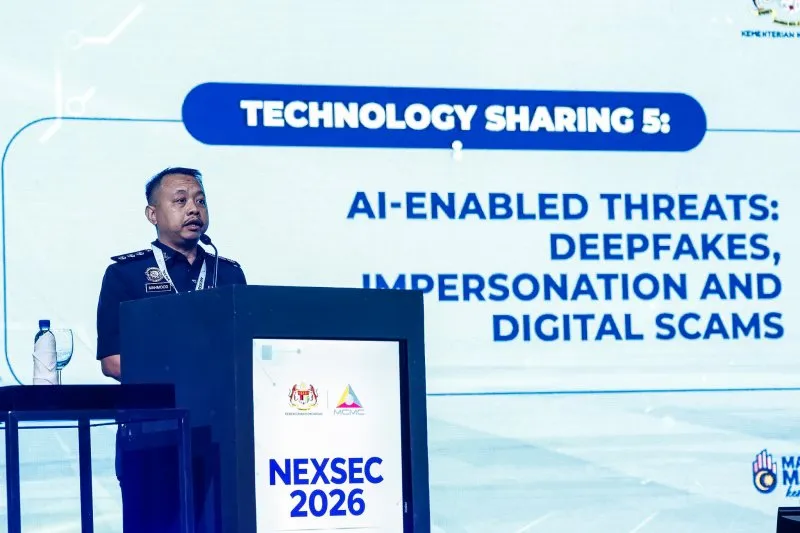
KUALA LUMPUR, Nov 26 — For every well-intentioned attempt to alert others by sharing suspicious videos or images, there is a risk of compromising scam investigations by stripping away the digital traces needed to establish whether the content is fake, police said.
Federal Commercial Crime Investigation Department (Digital Forensics) investigating officer Assistant Superintendent Mahmood Yahya said repeated forwarding through social media platforms compresses files, potentially stripping away microscopic pixel anomalies and metadata footprints that could help investigators establish the content’s origin.
He said such files could include fake impersonation videos or doctored images used in scams.
“What we want to do is trace the perpetrator or, more importantly, identify the original source of the material.
“Any police investigation must have a lead to follow. Once a file has been transferred through repeated copying and pasting, it is no longer the original file, making it difficult to trace its source.
“Even transferring the file just once may affect the digital information attached to it. That is how the technology currently works,” he told Malay Mail on the sidelines of NEXSEC2026, held at the Malaysia International Trade and Exhibition Centre (MITEC) here.
He acknowledged that this remained a challenge in scam investigations, as victims may have deleted the original files or forwarded them to multiple recipients, making it difficult for investigators to establish the source of the material and proceed effectively from the outset.
“That is why I always tell the public, do not screenshot, do not forward, preserve the original file.
“When you file a report and have evidence in your possession — whether images, videos, or voice messages — do not simply share or forward it to another friend.
“In the current situation, do not touch anything. Just go to the nearest police station and file a report. Unfortunately, this kind of scenario doesn’t happen quite often,” he said.
Mahmood also explained this could also raise legal issues over the admissibility and reliability of the evidence, which could be challenged in court.
This means that unless investigators can establish alternative evidence to trace the file back to its original source, identifying the person responsible and securing a prosecution will be difficult, he added.
Apart from preserving evidence, he also stressed that the first two hours after a victim discovers they have been scammed are crucial.
“Promptly contacting the National Scam Response Centre (NSRC) via its hotline 997 gives the joint task force a better chance of tracing, intercepting and freezing the funds before they leave the Malaysian banking system,” he said.
Sophistication
Mahmood also highlighted the increasingly sophisticated and common tactics used by scammers, including their ability to use AI to replicate Malaysian dialects and create convincing visual details, from the folds and texture of a tudung to realistic Jawi script on banners in the background.
The first involves scammers using silent calls to capture brief voice samples when victims answer their phones, which are then cloned to impersonate family members or acquaintances and solicit urgent money transfers.
The second involves scammers using deepfakes to hijack the faces of people Malaysians trust most, including national leaders, royalty and financial regulators, to exploit their credibility and trick victims into surrendering their life savings.
He cited a disclosure made by Communications Minister Datuk Seri Fahmi Fadzil in Parliament on November 17 that 1,178 of the 13,883 deepfake items removed between January 1, 2024 and October 31 this year involved political leaders.
The third involves AI-driven financial deception, in which syndicates use AI-generated personas, fake identity documents and automated phishing messages to bypass banks’ onboarding checks, hijack accounts and siphon off funds.
Mahmood then urged Malaysians to adopt several precautions, including checking bank accounts and recipient details through the PDRM Semakmule portal before making any transfers, establishing a secret family safe word to verify emergency requests, never share one-time passwords or transaction authorisation codes and hanging up before calling back on an official number they already trust.
“I leave you with one golden rule.
“Treat every voice, every face, and every video on your screen as unverified by default. Do not simply believe what you hear and what you see,” he said.
Date: 26 November, 2026 2:00 pm
Source: Malay Mail
💬 Join the Conversation! 💬
We’ve disabled comments on our posts and pages to keep the discussions organized and lively! But don’t worry – the conversation isn’t over. Head over to our forum and share your thoughts, ideas, and feedback with the community! It’s the perfect place to connect, learn, and engage with others who care about the same things. We can’t wait to hear from you!