
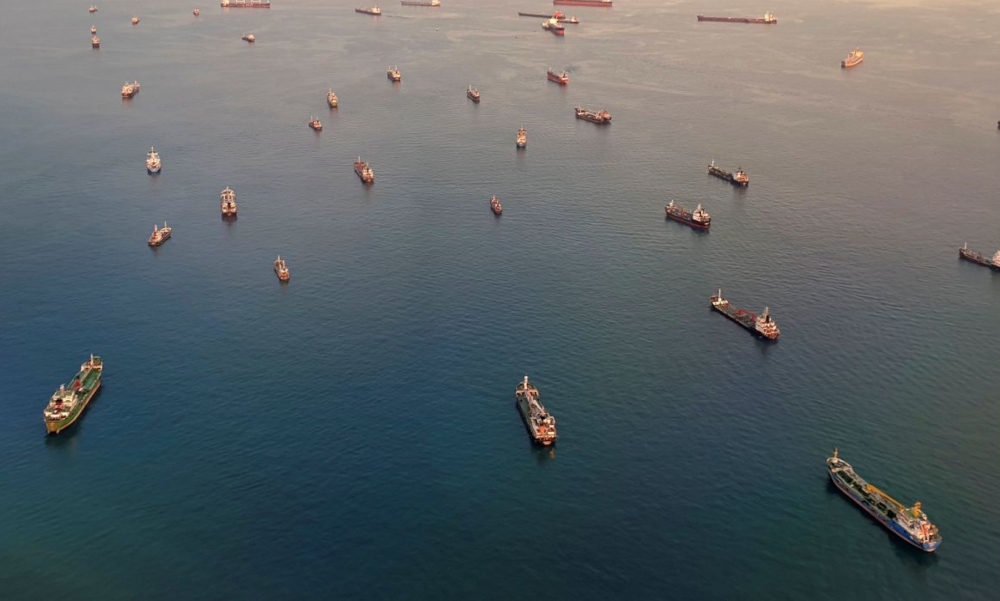
KUALA LUMPUR, April 6 — The Strait of Malacca, one of the world’s most important shipping lanes, remained the largest oil transit chokepoint globally in the first half of 2025 (1H25). The strait, which links the Indian and Pacific oceans, is the shortest sea route between West Asia and key markets in East and South-east Asia.
According to the US Energy Information Administration (EIA), the strait handled an estimated 23.2 million barrels of oil per day in 1H25, accounting for 29 per cent of total global maritime oil flows.
Crude oil and condensate made up most of the volume passing through the strait at 16.6 million barrels per day in 1H25, while petroleum products accounted for 6.5 million barrels per day. Liquefied natural gas (LNG) flows through the waterway reached about 9.2 billion cubic feet per day over the same period.
Key Persian Gulf Organisation of the Petroleum Exporting Countries (Opec) producers, namely Saudi Arabia, the United Arab Emirates, Kuwait and Iraq, accounted for nearly 60 per cent of the crude oil moving through the Strait of Malacca in 1H25. Flows through the strait fell in 2024 following Opec+ production cuts, but picked up again in the first half of 2025 after output targets were raised.
Iran continued to increase its oil exports through the strait, rising from 0.3 million barrels per day in 2020 to 1.6 million barrels per day in 1H25. Russian volumes remained relatively small at about 0.4 million barrels per day in 1H25.
In 1H25, the United States also sent 0.8 million barrels per day of crude oil and condensates from its Atlantic coast through the Strait of Malacca to East Asia.
China remained the single biggest destination for crude oil and condensate passing through the strait, taking in 7.9 million barrels per day, or 48 per cent of import volumes, in 1H25. Most of the crude oil moving along the route was shipped from West Asia to East Asian markets, reflecting the strait’s importance to regional energy trade.
South Korea and Japan were the next largest destinations, receiving 2.4 million barrels per day and 2.1 million barrels per day respectively in 1H25.
While alternative routes exist, including Indonesia’s Sunda and Lombok straits, ships using those paths would face longer voyages. The EIA also pointed to a pipeline linking Myanmar to southwest China as another partial alternative. Even so, the Strait of Malacca remains a key route for oil and LNG shipments from West Asia to East and South-east Asia. — Bernama
Date: 6 April, 2026 9:00 am
Source: Malay Mail
💬 Join the Conversation! 💬
We’ve disabled comments on our posts and pages to keep the discussions organized and lively! But don’t worry – the conversation isn’t over. Head over to our forum and share your thoughts, ideas, and feedback with the community! It’s the perfect place to connect, learn, and engage with others who care about the same things. We can’t wait to hear from you!