
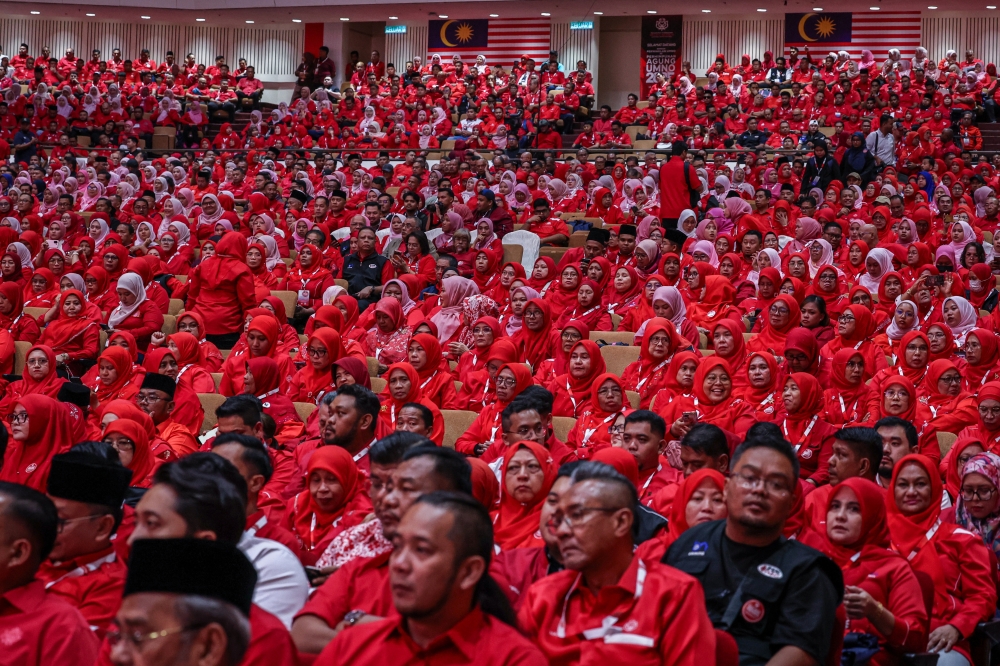
KUALA LUMPUR, Sept 9 — Umno’s general assembly begins today with the party facing a question that has become increasingly difficult to avoid: what does it want to be when the next general election arrives?
The four-day gathering at the World Trade Centre Kuala Lumpur comes after Umno’s electoral gains in Johor and Negeri Sembilan, a push to rebuild its ranks through the Rumah Bangsa initiative and growing questions over whether its partnership with Pakatan Harapan (PH) can hold until the next general election.
It is also the party’s second general assembly this year. The gathering held in January was the postponed 2025 assembly, making this the first regular PAU of 2026.
Umno secretary-general Datuk Asyraf Wajdi Dusuki said delegates would be free to table motions on the party’s political direction and its cooperation with the unity government, putting the grassroots debate among the key things to watch at the four-day assembly.
Asyraf has also described the annual gathering as Umno’s “Hari Raya” — a time for its grassroots to come together.
But the assembly comes at a consequential juncture for Umno.
Its recent electoral successes have given the party renewed confidence, while its position in the unity government has become increasingly complicated by competing political interests within the coalition.
Three issues that are likely to loom over PAU 2026.
1. Rumah Bangsa and Malay unity
If there was one defining political message from Umno’s last assembly, it was the call to rebuild the party’s house.
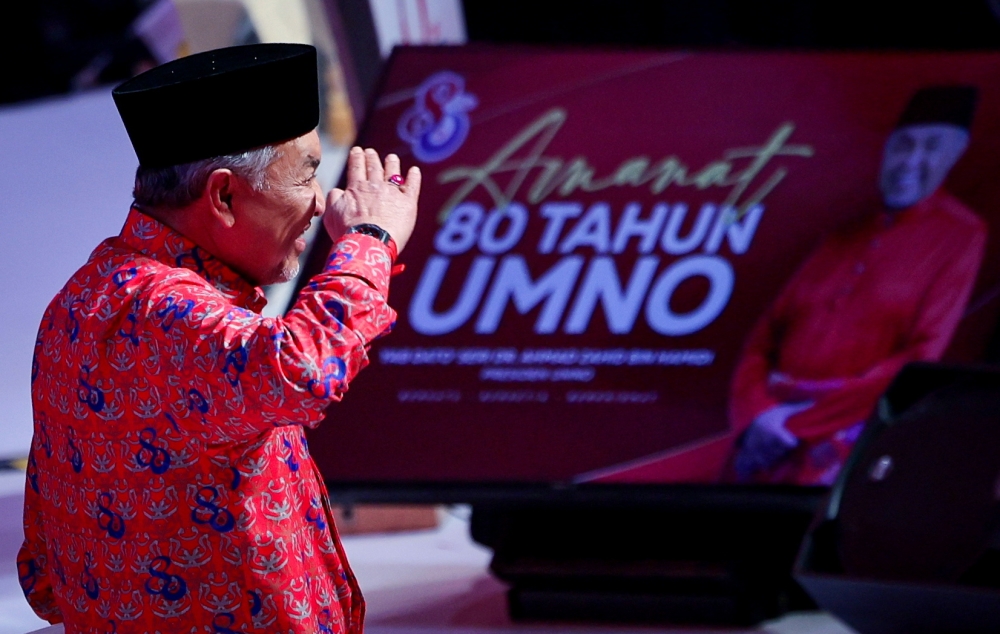
Rumah Bangsa was unveiled as an effort to bring back former members and broaden Umno’s appeal, with party president Datuk Seri Ahmad Zahid Hamidi repeatedly stressing that the party’s doors remained open.
Eight months on, the initiative has become more than a slogan.
Umno said in June that 21,858 new and returning members had joined through the initiative, including former members of other Malay-based parties.
Party leaders have framed Rumah Bangsa as an effort to bring Malays together under one political roof, with Umno supreme council member Datuk Seri Ahmad Maslan describing its approach as “forgive and forget”.
The initiative has also opened the door to former leaders and members, reinforcing the idea that Umno wants to reclaim political ground lost during years of fragmentation within the Malay electorate.
That message is likely to continue at PAU 2026.
The message of Malay-Muslim unity is also likely to feature prominently, particularly as Umno’s ties with PAS have warmed following their cooperation in Negeri Sembilan.
2. PAS, PN and the limits of the unity government
In the 15th general election, PAS and Umno fought over the same Malay-Muslim electorate. Today, their relationship is considerably more complicated.
The two parties remain on opposite sides of federal politics, with Umno part of Prime Minister Datuk Seri Anwar Ibrahim’s unity government while PAS remains the dominant force within Perikatan Nasional (PN).
But Negeri Sembilan has created a new reality.
Barisan Nasional (BN) won 18 of the state’s 36 seats in the August election, while PN secured seven. The two coalitions subsequently agreed to work together to form the state administration.
For Umno delegates, that arrangement offers something more substantial than political speculation: a working example of BN and PN cooperation.
Recent gestures between Umno and PAS have added to the interest.
PAS has accepted Umno’s invitation to attend PAU 2026 after Umno leaders attended PAS’ muktamar, continuing a reciprocal thaw between parties that once regarded each other as direct electoral threats.
PAS president Tan Sri Abdul Hadi Awang has also defended Umno-PAS cooperation as necessary for Malay-Muslim unity, while Zahid has said new Malay-based parties should unite rather than divide the community.
The question now is whether that cooperation remains confined to individual states or becomes part of a wider electoral calculation ahead of GE16.
That question is particularly relevant because Umno’s other political partnership is showing signs of strain.
Zahid has called for GE16 to be held earlier, while Anwar has indicated that he is in no hurry to call the election. Differences between ministries controlled by the two leaders have also increasingly spilled into public view.
For Umno, the contradiction is becoming harder to ignore.
The party is helping govern the country alongside PH while simultaneously championing Malay unity and deepening contacts with PAS and PN.
That does not necessarily mean Umno is preparing to leave the unity government.
But PAU is where its grassroots get to test the limits of that arrangement and signal how they want the party to position itself when the next election comes.
3. Melaka: Defend, but with whom?
Then there is Melaka, where the next electoral test is already on the calendar.
The state government’s mandate expires on December 31.
BN enters the contest as the incumbent after winning 21 of the 28 seats in the 2021 election, with Umno holding the bulk of those seats.
For Umno, the objective is straightforward: defend.
The political formula for doing so is not.
Should BN seek to contest largely on its own strength? Should Umno continue working with PH? Or does the Negeri Sembilan arrangement provide a template for some form of cooperation with PN?
Zahid has already warned that the formula used in Johor and Negeri Sembilan cannot simply be replicated in Melaka, saying the state requires its own strategy.
He has tasked Melaka Chief Minister and state BN chairman Datuk Seri Ab Rauf Yusoh with negotiating with other parties, with the eventual strategy to be brought to the national leadership for consideration.
That leaves delegates with a question that could become one of the most politically sensitive at this year’s assembly: who should Umno want beside it?
PAS has already made clear that it sees an opportunity in Melaka.
The Islamist party has set a minimum target of 15 of the state’s 28 seats, putting it on a potential collision course with Umno unless some form of electoral understanding is reached.
That makes Melaka more than a state-level contest.
It could become the first major test of whether the political accommodation seen in Negeri Sembilan can be reproduced elsewhere, or whether Umno’s relationship with PH remains the more useful electoral arrangement.
Date: 9 September, 2026 7:30 am
Source: Malay Mail
💬 Join the Conversation! 💬
We’ve disabled comments on our posts and pages to keep the discussions organized and lively! But don’t worry – the conversation isn’t over. Head over to our forum and share your thoughts, ideas, and feedback with the community! It’s the perfect place to connect, learn, and engage with others who care about the same things. We can’t wait to hear from you!