
DHAKA, Nov 3 —Bangladeshi garment worker Amena, who has spent seven years sewing and checking clothes for international brands, struggles at the end of the month to afford even the basics.
The 27-year-old, who like others interviewed by AFP gave only one name fearing professional repercussions, earns 12,500 taka (RM410), barely enough to cover the rent on her small home and support her elderly parents.
Her monthly wage is roughly equivalent to the retail price of a pair of yoga leggings or blue jeans in Europe or North America — garments like those made at the factory where she works in the Dhaka suburb of Gazipur.
“I earn 12,500 taka. The highest salary I ever drew was 26,000 taka, and that was years ago,” she said, adding her salary dropped when she was transferred to sampling from stitching.
Bangladesh, a nation of 170 million people, is the world’s second-biggest garment exporter behind China, producing clothes for major international brands.
The sector employs millions and generates the bulk of Bangladesh’s export earnings.
But workers say rising food, housing, transport and healthcare costs, compounded by inflation of around eight percent and soaring energy prices, have steadily eroded their purchasing power.
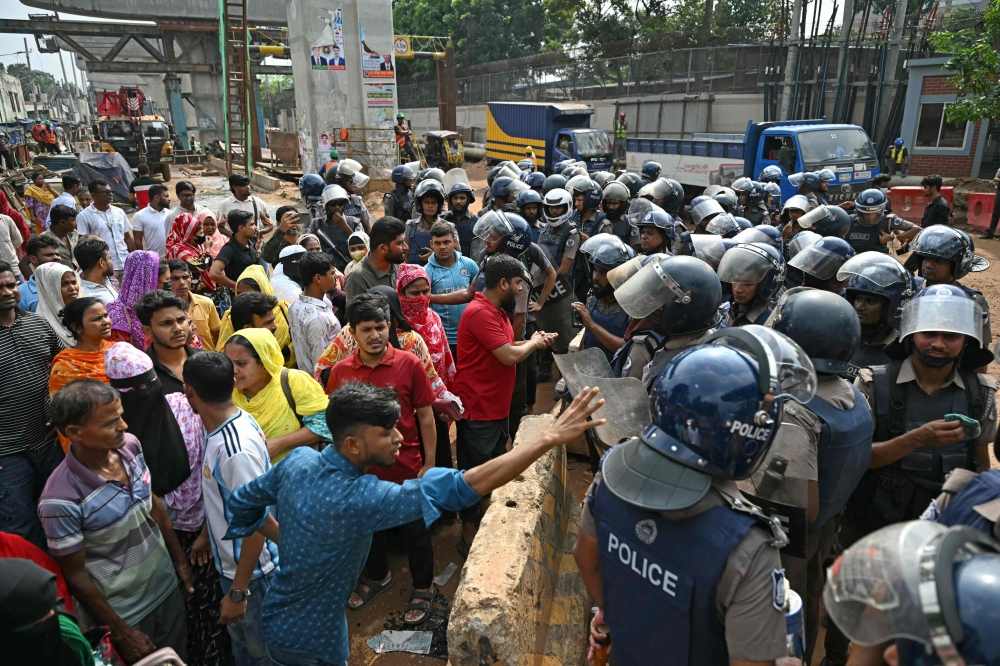
With strikes and protests since Saturday, they are demanding a minimum monthly wage of 30,000 taka — a 140 percent increase on the current minimum.
Protests have continued for days, with workers defying calls from the government and factory owners to return to work.
‘Kind of bonded labour’
Amena pays 4,500 taka a month in rent and sends another 5,000 to her parents, leaving just 3,000 for food, medicine or emergencies.
“Now I have no savings left to fall back on,” she said. “My bones are deteriorating, so I need to take medication. I can’t afford to buy fish or meat regularly.”
She usually buys some just after receiving her salary, in the first week of the month, and perhaps again two weeks later.
“It’s impossible to live like this, but we have no other options,” she said. “It’s a kind of bonded labour, although nobody is forcing us to continue working. We need jobs, and garment factories are the only option available to us.”
“The government and factory owners should concede to our demands because they are legitimate,” Amena said. “How are we supposed to survive when the prices of all commodities keep rising?”
Sabbir, 18, works at a small factory, earning a monthly salary of 12,000 taka.
After paying rent on a small room near her factory, “I keep 1,500 taka as pocket money and give the rest to my mother,” Sabbir told AFP.
“The price of gas has soared” since the Middle East war erupted in late February, she said. “We are always afraid that the gas might run out.”
Begum, another garment worker in Gazipur, said employees had little faith in promises from factory owners.
“Whenever we ask for a salary increase, the owners start complaining that business isn’t going well,” she said.
“If that’s true, how come the same owners keep opening factories one after another?” — AFP
Date: 3 November, 2026 8:30 pm
Source: Malay Mail
💬 Join the Conversation! 💬
We’ve disabled comments on our posts and pages to keep the discussions organized and lively! But don’t worry – the conversation isn’t over. Head over to our forum and share your thoughts, ideas, and feedback with the community! It’s the perfect place to connect, learn, and engage with others who care about the same things. We can’t wait to hear from you!