
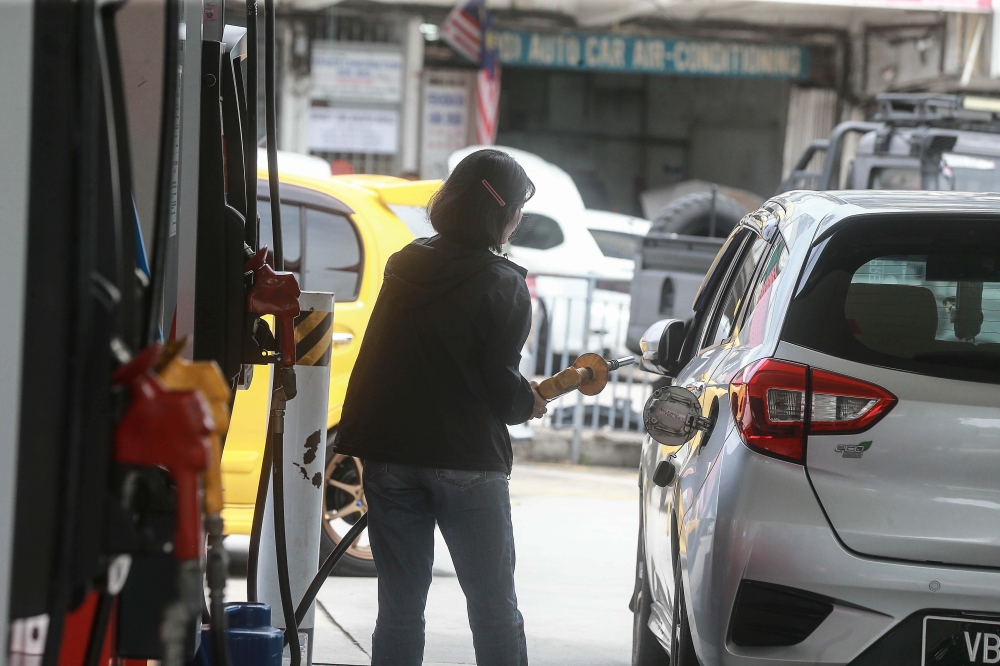
KUALA LUMPUR, Aug 27 — Is 200 litres of subsidised RON95 enough to get through the month?
That is a question some motorists are still asking after the government reduced the monthly Budi Madani RON95 (Budi95) eligibility limit from 300 litres to 200 litres, effective April 1, 2026.
While RON95 fuel subsidised under Budi95 remains at RM1.99 a litre, the unsubsidised price for August 20 to 26 was RM3.77 a litre.
The Ministry of Finance (MOF) confirmed that the government bore RM1.78 a litre in subsidies for eligible users that week.
With households grappling with the rising cost of living, concern over whether 200 litres is enough is understandable.
So, how far does 200 litres go? It depends
How far 200 litres goes depends on the car, the distance travelled and how often it is used.
For a short daily commute, 200 litres could be more than enough, while a vehicle that spends much more time on the road could run out sooner.
Government data, however, shows that nearly 90 per cent of eligible Budi95 users consume less than 200 litres a month, with average monthly consumption at around 100 litres.
Finance Minister II Datuk Seri Amir Hamzah Azizan subsequently said actual Budi95 usage data from October 2025 to June 2026 showed that “fewer than one per cent of Budi95 users consistently consume more than 200 litres of RON95 per month.”
200 litres, different cars, very different distances
One way to understand the allocation is to look at manufacturers’ published fuel-efficiency figures.
Distances shown are calculations based on 200 litres and published fuel-efficiency figures from the manufacturers’ respective test cycles.
Actual fuel consumption varies with traffic, road conditions, air-conditioning, vehicle load and driving style.
What about everyday city driving?
Published fuel-efficiency figures are based on standardised tests and do not necessarily reflect stop-start Malaysian traffic.
For a more conservative illustration, assume a vehicle averages 10km per litre in city driving.
At that rate, 200 litres would cover about 2,000km.
For someone commuting 22 working days a month:
Route distances are approximate road distances.
Fuel use is calculated using an illustrative 10km/L city-driving assumption and 22 working days a month; actual consumption varies.
Someone travelling 100km a day for work could therefore theoretically use more than 200 litres before accounting for other trips.
A roughly 23km one-way road journey between Kuala Lumpur and Shah Alam would work out to about 101 litres a month at 10km/L, assuming a return trip on 22 working days.
These are illustrations rather than estimates of actual consumption for every driver.
What about those who use more than 200 litres?
Amir had said fewer than one per cent of Budi95 users consistently consume more than 200 litres a month.
Consumption can vary depending on distance travelled, location, vehicle type, traffic and whether driving is part of someone’s work.
For e-hailing drivers, MOF announced a tiered system under which drivers travelling 2,000 to 5,000km a month can receive up to 600 litres, while those travelling more than 5,000km can receive up to 800 litres.
When the ordinary Budi95 ceiling was reduced to 200 litres, MOF said the additional quota cap for e-hailing operators would remain at 800 litres a month.
Why not simply make petrol cheaper?
But if some motorists are concerned that 200 litres is not enough, why can’t the government simply spend more to subsidise more fuel — or make petrol cheaper?
Put simply, the government has said it cannot continue absorbing such high costs.
MOF said in March that subsidies for RON95 and diesel had amounted to about RM700 million in January 2026, while the bill was estimated to reach around RM4 billion a month as crude oil prices rose above US$100 (RM402) a barrel.
That volatility matters because the cost of keeping petrol subsidised is not fixed.
How much would it cost to increase the subsidy by one sen?
Treasury secretary-general Datuk Johan Mahmood Merican said Malaysia consumes about 18 billion litres of fuel a year, with households accounting for about 78 per cent of RON95 consumption.
If all 18 billion litres attracted an additional one sen of subsidy, the annual cost would be about:
18 billion litres × RM0.01 = RM180 million
An additional one sen of subsidy per litre would therefore represent roughly RM180 million a year, assuming consumption remained unchanged and all 18 billion litres attracted the additional subsidy.
That is a calculation based on the government’s consumption figure, not an official estimate of the cost of a one-sen price reduction.
Ten sen a litre would amount to about RM1.8 billion.
The calculation shows why a seemingly small change at the pump can become a substantial fiscal commitment when applied across billions of litres.
Where to draw the line
For an individual driver, another few sen of subsidy may not seem significant.
Across billions of litres of RON95, however, even a small increase in the subsidy can translate into hundreds of millions of ringgit in additional government spending.
That is the trade-off behind Budi95: keeping subsidised petrol affordable while limiting the fiscal cost of providing it to everyone.
Small ways to make fuel go further
Fuel consumption is not entirely within a driver’s control, as traffic, road conditions, vehicle type and distance travelled all matter.
But some simple habits can reduce unnecessary consumption:
-
Keep tyres properly inflated, as under-inflated tyres increase rolling resistance.
-
Avoid prolonged idling where practical and safe, as a stationary engine still consumes fuel.
-
Combine trips when convenient, as several separate journeys can add unnecessary kilometres.
-
Drive smoothly, as repeated hard acceleration and braking can increase fuel consumption.
-
Keep the vehicle maintained, as a properly serviced vehicle is more likely to operate efficiently.
-
Plan journeys, as combining errands and avoiding unnecessary detours can reduce the distance travelled.
Date: 27 August, 2026 7:30 am
Source: Malay Mail
💬 Join the Conversation! 💬
We’ve disabled comments on our posts and pages to keep the discussions organized and lively! But don’t worry – the conversation isn’t over. Head over to our forum and share your thoughts, ideas, and feedback with the community! It’s the perfect place to connect, learn, and engage with others who care about the same things. We can’t wait to hear from you!