
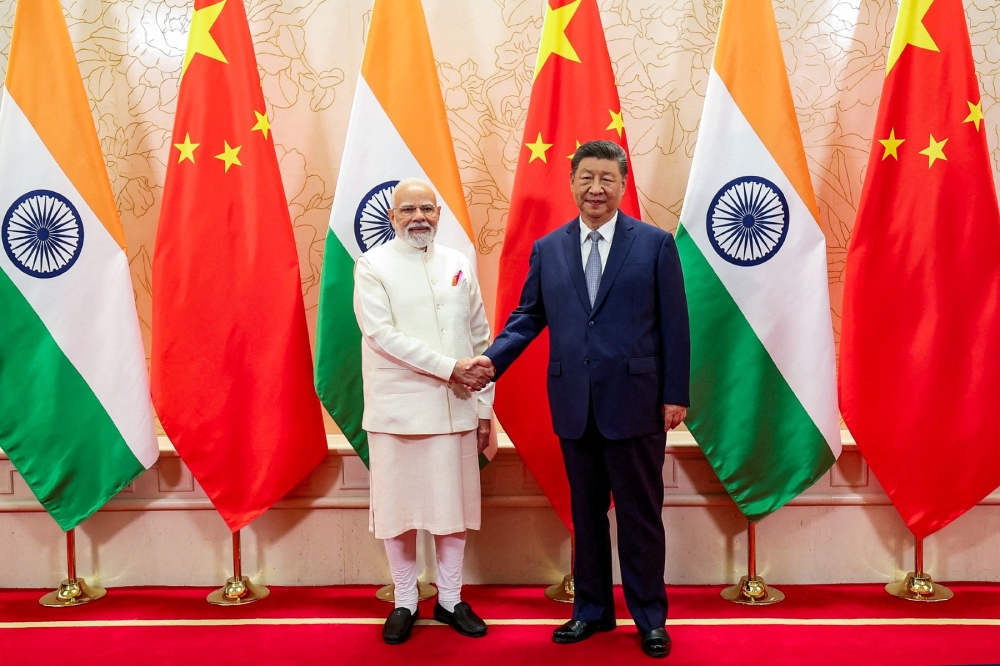
NEW DELHI, Sept 10 — Chinese President Xi Jinping heads to India for a summit on Saturday that could mark the biggest step in a cautious thaw after years of hostility between the two countries.
Xi’s visit for the September 12-13 BRICS summit would be his first trip to India since October 2019, and follows Prime Minister Narendra Modi’s August 2025 visit to China.
The nuclear-armed Asian giants have been slowly improving ties since a deadly 2020 border clash. Flights, some visas and high-level contacts have gradually resumed.
But deep mistrust remains, with their disputed Himalayan frontier, a heavy trade deficit and strategic rivalry complicating ties.
Here are five things to know:
Border comes first
The relationship was transformed by the June 2020 Himalayan border clash, when fighting in Ladakh killed 20 Indian and four Chinese soldiers.
In October 2024, Beijing and Delhi agreed on patrolling arrangements, paving the way for renewed political contacts.
But the underlying territorial dispute remains unresolved, and both sides retain heavy military deployments along their roughly 3,500-kilometre (2,175-mile) high-altitude border along Tibet.
“They are looking for ‘early and substantial harvest’ when it comes to the border issue,” said Pradeep Taneja, a China-India expert at the University of Melbourne.
“You cannot have a buildup of your forces on the border… but at the same time say ‘we should continue to have people-to-people relations and economic relationships.’”
The Dalai Lama also lives in exile in India, ever since the Buddhist spiritual leader fled the Tibetan capital Lhasa after Chinese troops crushed an uprising in 1959.
Beijing condemns the Dalai Lama as a rebel and separatist.
Unequal trade ties
China is now India’s largest trading partner, with bilateral goods trade reaching US$151 billion (RM635 billion) in the 2025-26 financial year, according to Indian government data.
But the relationship is heavily tilted towards Beijing.
India imported US$131 billion (RM551 billion) of goods from China, while exports were US$19 billion (RM80 billion), leaving a record US$112 billion (RM471 billion) trade deficit.
Modi’s government is pushing domestic manufacturing and seeking to reduce dependence on China for machinery, electronics, chemicals and industrial components.
But Wu Xinbo, dean of the Institute of International Studies at Shanghai’s Fudan University, said India needs Chinese technology.
“India… need China’s – not just investment – but more and more technology,” he said.
China, he added, also wants to expand trade “even though India keeps complaining about the trade imbalance”.
Partners and rivals
Both are members of BRICS and the Shanghai Cooperation Organisation (SCO).
Taneja argued that for Beijing, Xi’s “primary reason” for the visit is to bolster BRICS as an “alternative institution” to US-dominated institutions.
But they are also competitors.
India’s security partnership with Washington, including its participation in the so-called Quad security alliance with Japan and Australia, is viewed warily by Beijing.
China’s close relationship with India’s arch-rival Pakistan is looked at with concern by New Delhi.
“The very fact that President Xi is coming to India does indicate that… even if it’s because of the turbulence in the world caused by America, the two countries want a working relationship,” said Ashok Malik of The Asia Group.
Confidence-building measures
Ties have slowly warmed since 2024. That includes moves to revive border trade across their Himalayan frontier, ease visas, and allow Indians to resume a key Hindu pilgrimage to Tibet’s Mount Kailash.
Direct flights, suspended for more than five years, resumed in October 2025.
“The relationship is now being put back on track,” said Harsh V. Pant, of India’s Observer Research Foundation.
“But it is more stabilisation, rather than any dramatic change.”
Test, not breakthrough
Modi and Xi last held formal bilateral talks at the SCO summit in Tianjin in August 2025.
Their brief interaction at this month’s SCO summit in Bishkek offered another public signal of a thaw.
But analysts remain cautious.
“The mistrust between India and China is so huge,” said Pant. “Unless there is a demonstrable shift in Chinese behaviour, it is very unlikely that many in India would buy the India-China friends narrative.” — AFP
Date: 10 September, 2026 8:30 pm
Source: Malay Mail
💬 Join the Conversation! 💬
We’ve disabled comments on our posts and pages to keep the discussions organized and lively! But don’t worry – the conversation isn’t over. Head over to our forum and share your thoughts, ideas, and feedback with the community! It’s the perfect place to connect, learn, and engage with others who care about the same things. We can’t wait to hear from you!