
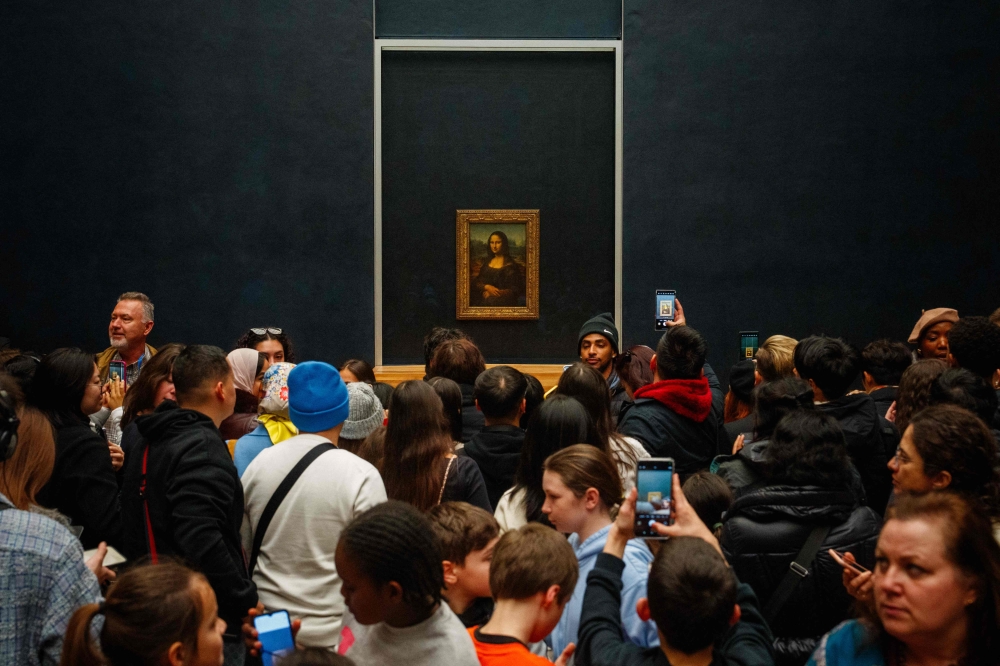
MOSCOW, August 2 — A court in Moscow rejected a copyright claim on a neural network-generated images based on Leonardo da Vinci’s Mona Lisa and the Statue of Liberty, saying that their generation is not creative work, but a technical process, according to documents seen by RIA Novosti.
The plaintiff claimed that by processing a reproduction of da Vinci’s masterpiece and a photo of the Statue of Liberty in a neural network, he created the art objects Mona Lisa with Wine and Statue of Liberty with Wine, which the defendant used on T-shirts, hoodies, sweatshirts, and thermal mugs, which he sold on his website.
The plaintiff asked the court to order compensation from the individual entrepreneur for violating the author’s exclusive rights to the design works. The defendant denied the claim, arguing that the plaintiff’s use of images with minor modifications to the original works was insufficient to qualify the resulting images as creative work and therefore not protected by copyright.
The plaintiff insisted in court that he had purchased photographs to create the works, in which he replaced the Statue of Liberty’s torch with a wine glass and added a background to the image.
He also altered the position of the Mona Lisa’s hand, the mouth, and the contours of her face, increased the volume of her hair and tousled it, added bags under her eyes and applied patches, and placed a wine glass in her hand with painted nails, according to the court filings.
The court noted that the disputed images had been created by artificial intelligence (AI), and since it lacked consciousness, it could not be said that the AI exerted creative effort. According to the court, the idea of tousled hair, a puffy face, a glass of wine in hand, and the replacement of the Statue of Liberty’s torch with a glass of wine are not new and are often used in art and media.
“The objects presented by the plaintiff cannot be independent objects of copyright protection, since giving prompts to artificial intelligence are simple mechanical actions and are purely technical in nature. In this case, giving commands to a computer programme to apply an existing idea (repeatedly implemented) to a previously existing work cannot be considered a creative contribution. His contribution is limited to clarifying the commands, which is not considered creative,” the court stated.
It dismissed the plaintiff’s copyright claim. — Bernama-Sputnik/RIA Novosti
Date: 2 August, 2026 9:00 pm
Source: Malay Mail
💬 Join the Conversation! 💬
We’ve disabled comments on our posts and pages to keep the discussions organized and lively! But don’t worry – the conversation isn’t over. Head over to our forum and share your thoughts, ideas, and feedback with the community! It’s the perfect place to connect, learn, and engage with others who care about the same things. We can’t wait to hear from you!