
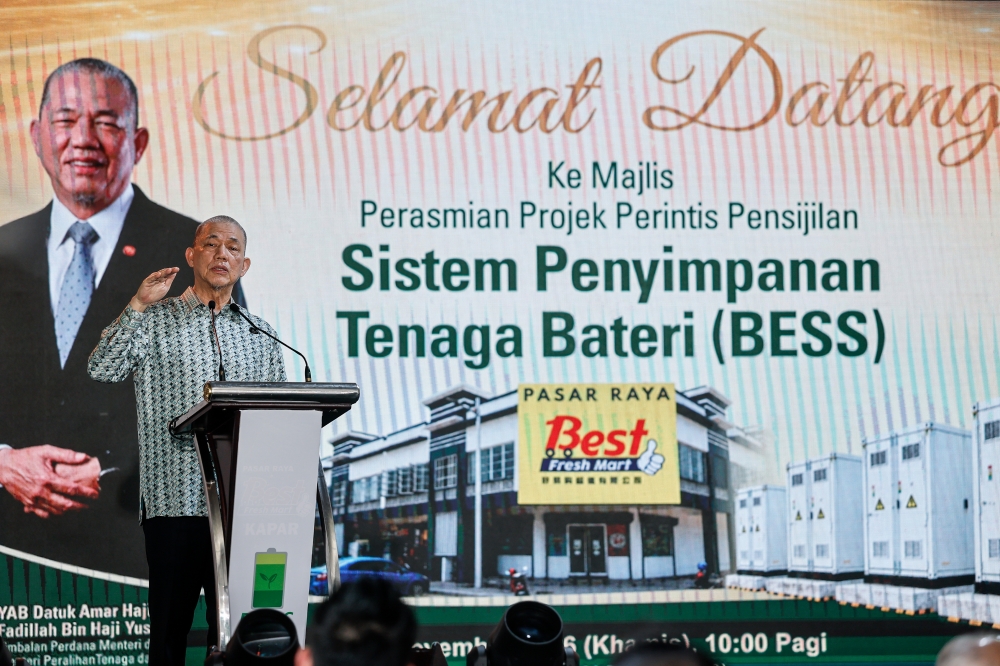
KLANG, Nov 12 — Malaysia needs to strengthen safety standards and certification for battery energy storage systems (BESS) to ensure that the technology can be used safely and sustainably, in line with national efforts to accelerate the transition to renewable energy.
Deputy Prime Minister Datuk Seri Fadillah Yusof said safety must be a top priority in developing energy storage technology, given that system failures could lead to risks such as thermal runaway and fires.
Fadillah, who is also the energy transition and water transformation minister, said every BESS installation must adhere to high standards of safety, quality, and performance as well as meet technical requirements and international best practices.
“It is not enough to simply possess technology. We must also ensure that the technology entering the country is safe. Therefore, what is being implemented here is a system that monitors safety aspects and establishes standards to ensure that installed batteries meet the prescribed requirements and criteria.
“That is why the development of this certification is crucial — not only to protect consumers but also to prevent explosions and fires that could pose dangers to users and the general public,” he said at the launch of the BESS certification pilot project by BESSC Sdn Bhd in Kapar today.
Although the certification scheme is voluntary, he encourages companies intending to install battery storage systems to seek guidance and use established standards to ensure safety and a return on investment for the industry, he said.
Hence, he hopes all relevant ministries and agencies — including the Standards Department Malaysia and the Energy Commission — will collaborate to develop standards suitable for domestic use as well as serve as a potential benchmark at regional and international levels.
Fadillah said Malaysia currently has an installed renewable energy capacity of nearly 14 gigawatts (GW) — about 32 per cent of the country’s total renewable energy capacity — with solar energy as a primary growth driver.
He added that the government has targeted renewable energy sources to comprise 35 per cent of power generation capacity by 2030, rising to 70 per cent by 2050.
This aligns with efforts to strengthen energy security, reduce reliance on fossil fuels, and achieve net-zero carbon emissions as early as 2050.
However, the rise in solar energy adoption also challenges electrical grid stability because this energy source is intermittent and dependent on weather conditions. This necessitates a system capable of balancing out fluctuations in electricity supply.
He said BESS stores excess solar energy generated during the day for use at night, and it helps to stabilise the grid by regulating the amount of energy fed into the system.
According to him, the growth of the BESS industry also creates opportunities for local companies — in system installation and battery manufacturing.
Among the government’s initiatives to expand the adoption of this technology is the MyBEST tender, which involves a battery power capacity of 400 megawatts (MW) and an energy capacity of 1,600 megawatt-hours (MWh).
Additionally, the sixth large-scale solar (LSS6) programme mandates the inclusion of battery components for relevant projects, with a power capacity of 1,250 MW and an energy capacity of 5,000 MWh. — Bernama
Date: 12 November, 2026 2:16 pm
Source: Malay Mail
💬 Join the Conversation! 💬
We’ve disabled comments on our posts and pages to keep the discussions organized and lively! But don’t worry – the conversation isn’t over. Head over to our forum and share your thoughts, ideas, and feedback with the community! It’s the perfect place to connect, learn, and engage with others who care about the same things. We can’t wait to hear from you!