
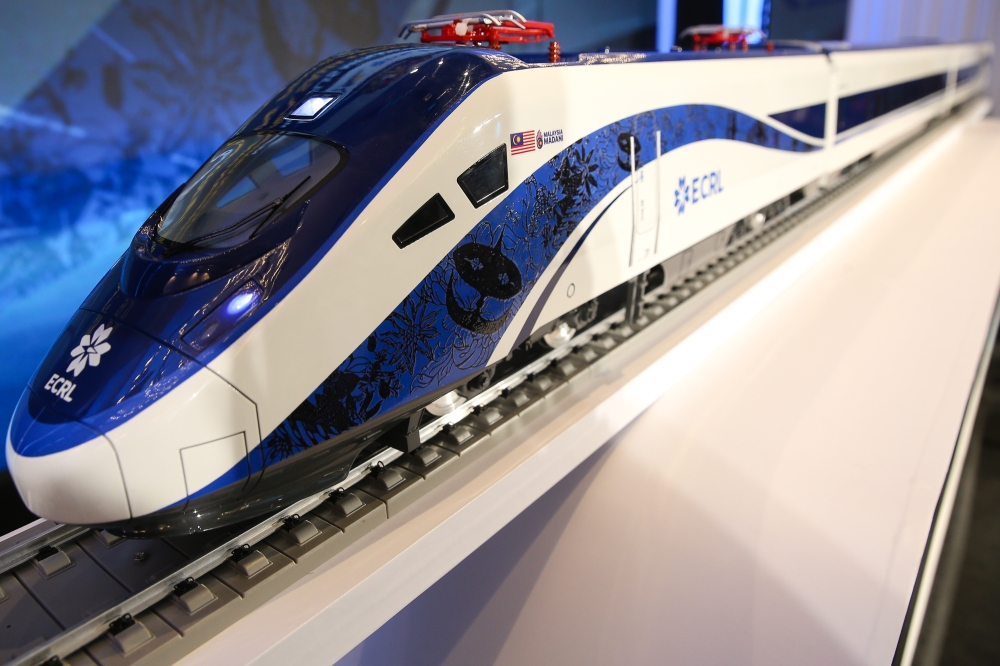
KUALA LUMPUR, Nov 11 — For travellers heading to the East Coast, the options may soon extend beyond the familiar bus, plane or car, with the East Coast Rail Link (ECRL) set to offer another way to get there.
But choosing how to travel may depend on more than just the ticket price, as the ECRL, buses, flights and driving each come with different trade-offs in journey time, convenience and overall door-to-door costs.
With ECRL passenger services set to begin on December 12, the question is which mode of transport offers the best value once ticket prices, fuel, tolls, parking and transfers are factored in.
What the numbers say
The ECRL’s 523km Gombak-Kota Bharu route provides a basis for comparing the available travel options.
One-way Economy fares start at RM125 per person for Transit services and RM147 for Express services.
However, fares may vary depending on travel time, demand and seat availability. Discounts are available for students, children aged two to 12, Malaysians aged 60 and above, persons with disabilities and government pensioners.
Express trains are expected to take about four hours, stopping at four main stations, compared with up to five hours for Transit services, which stop at all 16 scheduled stations.
Conventional express buses remain cheaper, with one-way fares from Kuala Lumpur to Kota Bharu ranging from RM44 to RM68. However, the journey takes about nine hours and 30 minutes under ideal traffic conditions.
Flying offers the fastest journey, with direct flights from Kuala Lumpur to Kota Bharu taking about an hour and 10 minutes. One-way fares range from RM123 to RM167, comparable with ECRL tickets.
For motorists, using subsidised Budi95 petrol at RM1.99 per litre and an illustrative fuel consumption rate of 4.5 litres per 100km for a Perodua Myvi 1.3L, the estimated one-way cost of driving about 420km from Gombak to Kota Bharu is RM37.60 for petrol and RM17 in tolls.
This brings the estimated one-way cost to RM54.60, excluding parking and other incidental expenses, for a journey of about six hours and 25 minutes under ideal traffic conditions.
A new train, a new choice
For 24-year-old journalist Wong Ci En, the ECRL offers another travel option for trips back to her hometown of Chukai, Terengganu, where convenience and journey time are key considerations.
Wong said she usually takes an express bus when travelling alone or hitches a ride with a family member, with the journey by road taking between four and five hours.
“One-way express bus tickets from Terminal Bersepadu Selatan to Chukai cost almost RM50, while an ECRL ticket from Terminal Bersepadu Gombak (TBG) to Chukai costs RM69.
“I will definitely consider using ECRL because it is fast, has no traffic congestion and saves a lot of time,” she said, noting that the estimated journey time on the ECRL was less than three hours.
Still, Wong said the distance between her current home in Seri Kembangan, Selangor, and TBG could deter her from taking the ECRL.
However, she said she would seriously consider the service if the inconvenience of last-mile travel could be addressed.
For 31-year-old pharmacist See Hui Qi, who travels frequently between Kuantan, Pahang, and Kuala Lumpur, the ECRL offers another option, with convenience, journey time and affordable fares influencing her choice.
She currently prefers driving or taking the bus from Kuantan to Kuala Lumpur to visit her siblings or catch flights from KLIA.
“Yes, I might consider taking the ECRL, especially during festive seasons when traffic congestion is common.
“Since I live in Petaling Jaya, connecting to the Kelana Jaya Line via Gombak station through the TBG interchange would also make it a feasible option for my future trips.
“In terms of the time saved, I think the ECRL ticket prices are reasonable for me,” she said.
Still, she said she would prefer travelling with her family for greater comfort, while prioritising convenience and journey time when travelling alone.
For 55-year-old university lecturer Khairana Sabtu, who travels with her family of five to Kota Bharu, Kelantan, to visit her parents, the ECRL is a timely addition that offers an alternative to road travel.
Although she prefers driving, she recalled being stuck in heavy traffic for almost 23 hours during a Hari Raya trip in 2022.
“I think the ECRL is the best choice for travelling back to Kota Bharu, as the ticket fares are affordable for my family and me, while the shorter journey time is another advantage.
“I just hope the ticket price will remain the same, especially during festive seasons and school holidays,” she said.
Beyond ticket prices, comfort is another key consideration. Khairana said she expected the ECRL to offer a journey as comfortable as that of KTM’s Electric Train Service (ETS), which she had previously taken to Penang and Johor.
Which is the best choice?
Ultimately, the best option depends on the balance travellers are willing to strike between cost, journey time and convenience.
While express buses offer the lowest fares, journey times can exceed 10 hours during peak festive periods because of traffic congestion, with extreme gridlock sometimes stretching trips to as long as 20 hours.
Although buses remain an economical option for budget-conscious travellers, prolonged journeys can be tiring, particularly for those travelling with young children or older family members.
Flights offer the quickest journey, but travellers must factor in additional time for airport transfers and check-in, as well as the cost of getting to the airport. Fares can also fluctuate with demand, potentially increasing travel costs for those booking at short notice or travelling in larger groups.
Driving offers greater flexibility, particularly for families and groups, but the overall expense depends on the vehicle, fuel consumption, driving conditions and route, with other incidental costs adding to the bill.
Journey times can also increase significantly during school holidays and festive seasons, making long drives more exhausting for families travelling with children or older people.
The ECRL offers a faster and potentially more comfortable alternative to road travel, with predictable journey times and less physical fatigue than driving or spending long hours on a bus.
However, fares can add up, especially for large groups and return trips, while passengers are restricted to designated stations and may need additional transport to reach their final destinations.
Date: 11 November, 2026 7:00 am
Source: Malay Mail
💬 Join the Conversation! 💬
We’ve disabled comments on our posts and pages to keep the discussions organized and lively! But don’t worry – the conversation isn’t over. Head over to our forum and share your thoughts, ideas, and feedback with the community! It’s the perfect place to connect, learn, and engage with others who care about the same things. We can’t wait to hear from you!