
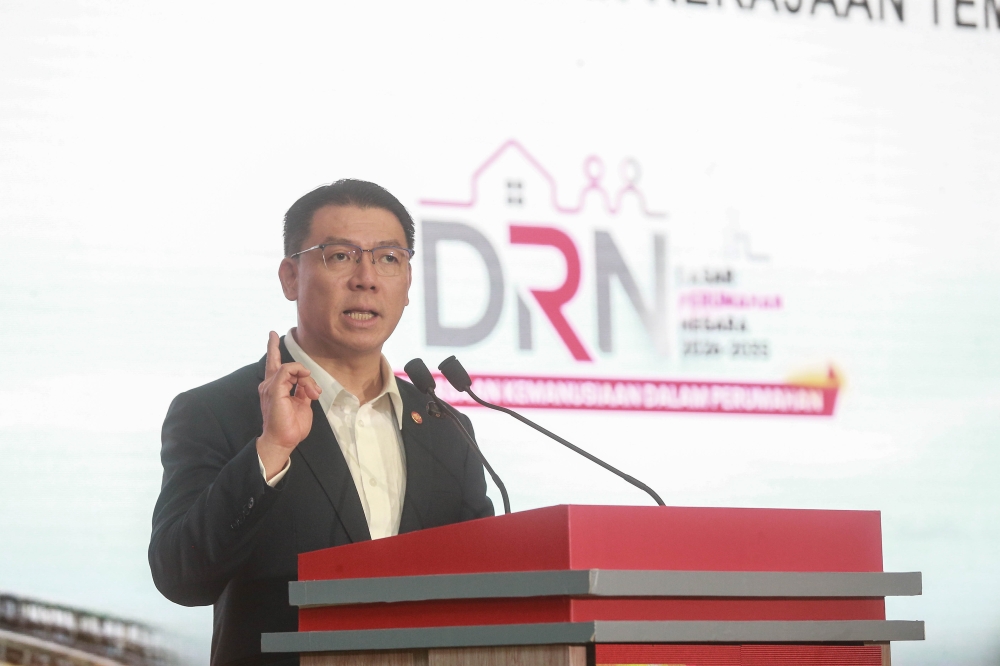
KUALA LUMPUR, Aug 10 — Housing development will be planned according to local needs and market demand starting next year to reduce unsold homes under the new National Housing Policy 2026-2035 (DRN 2026-2035).
Housing and Local Government Minister Nga Kor Ming said the shift towards more data-driven planning was among the key changes under the policy, which seeks to address the mismatch between housing supply and demand while expanding access to affordable home ownership.
“Starting next year, housing development will be planned according to local needs, location and market demand. Through this approach, we hope to reduce the oversupply of unsold properties in the future,” Nga said in his address during the launch of the National Housing Policy 2026-2035 today.
Themed “Humanising Housing”, the policy is aimed at addressing challenges including rising living costs, demographic changes, mismatches between housing supply and demand, unsold properties, as well as delayed, sick and abandoned housing projects.
It comprises six focus areas, 17 strategies and 59 action plans, with a target of providing one million affordable homes by 2035 through a more comprehensive, integrated and data-driven approach.
The policy also seeks to ensure that affordable housing prices are better aligned with local incomes and the needs of residents.
At a separate press conference, Nga said big data analytics would allow housing needs to be assessed according to individual districts and locations, including the number and types of homes required.
He said the system would also take into account local income levels and property prices, allowing the definition of affordable housing to better reflect differences between areas.
“Imagine having an affordable home in Kuala Krai, Kelantan, at the same price as one in Bukit Bintang, Kuala Lumpur. That is not scientific. That is why we need big data analytics,” he said.
Nga said developers would eventually be able to subscribe to the system and use the data when planning projects, although its use would not be mandatory.
He said the system could help developers determine the type of housing, price and location that would better match local demand.
“If big data analytics shows that a particular district needs 5,000 housing units, with different types of homes, developers can refer to the big data analytics when planning their projects,” he said.
Nga said the system would combine data from relevant agencies and the Housing and Local Government Ministry (KPKT) before being made available to industry players.
He said artificial intelligence would also support the system by helping identify suitable housing products, prices and locations based on local conditions.
“We cannot set a target of one million homes if there is no need for them. That is why big data analytics comes in,” he said.
“We set the target to ensure Malaysians have homes according to their respective needs and affordability.”
Nga said changing socio-economic circumstances, including the growing number of people earning through the gig economy, entrepreneurship, flexible employment and digital businesses, meant housing financing also needed to evolve.
“The employment landscape today has changed, requiring a more inclusive financing approach that is suited to current realities,” he said.
The government will strengthen existing instruments such as the Housing Credit Guarantee Scheme (SJKP), which has a RM40 billion facility.
Nga said 95,000 first-time homebuyers had benefited from SJKP so far, with the ministry aiming to assist 100,000 first-time buyers through the scheme.
The policy will also expand access to home ownership through mechanisms including Rent-to-Own (RTO), Shared Ownership, Fixed Rate Mortgage (FRM) and SJKP.
“These approaches are aimed at expanding opportunities for home ownership among more Malaysians without relying on just one financing model,” Nga said.
The policy also proposes the enactment of a Residential Tenancy Act to establish a more comprehensive regulatory framework for the rental market and create a fairer relationship between tenants and landlords.
Nga said the ministry was preparing the proposed legislation to create a more transparent, secure and balanced residential rental market.
Another focus is transit-oriented development (TOD), with the government seeking to provide housing with better access to public transport.
Nga said Malaysia had invested billions of ringgit in public transport infrastructure and housing development should help optimise its use, particularly among lower-income groups.
“It is time for housing development to encourage and optimise the use of public transport,” he said.
He said better access to public transport could reduce reliance on private vehicles while supporting Malaysia’s aspiration to achieve a carbon-neutral economy by 2050.
The DRN 2026-2035 will also promote the use of modern construction technologies, including artificial intelligence, big data analytics, Building Information Modelling (BIM), Industrialised Building System (IBS) and Prefabricated Prefinished Volumetric Construction (PPVC).
Nga said technology could improve productivity and speed up project delivery while helping the government make more accurate decisions.
“Modern technology is not merely about increasing the efficiency of the industry. It also helps the government make more accurate decisions, reduce wastage and ensure homes can be completed faster and with better quality,” he said.
At the same time, the DRN 2026-2035 places greater emphasis on housing that is inclusive and age-friendly, including meeting the needs of senior citizens and people with disabilities.
Nga said housing planning needed to take into account the needs of older Malaysians so they could continue to live active, independent, comfortable and safe lives in age-friendly communities.
The policy also seeks to strengthen the management of strata communities.
Malaysia currently has nearly three million strata property units across more than 27,000 strata schemes.
Nga said problems such as water leaks, poor cleanliness, poorly maintained public facilities and weak management could directly affect residents’ quality of life and property values.
“We need to ensure that every strata community is managed efficiently, transparently and responsibly so that residents and property owners can enjoy a more comfortable, safe and quality environment,” he said.
The government will strengthen strata management through amendments to the Strata Management Act 2013 (Act 757), while strengthening the accountability and governance of Joint Management Bodies (JMBs), Management Corporations (MCs) and Commissioners of Buildings (COBs).
Nga said every strategy and action plan under the policy would be supported by efficient governance, continuous monitoring and close cooperation with state governments, local authorities, financial institutions, industry players, professional bodies and other stakeholders.
He added the policy would also be reviewed and improved from time to time to ensure it remained responsive to changes in demographics, technology and the economy, as well as the needs of the people.
“DRN 2026-2035 is not merely a development plan for the housing sector, but also a commitment by the Madani Government to ensure every citizen has access to quality, affordable housing that supports their well-being,” Nga said.
“Quality housing is not merely about providing shelter, but also forms the foundation for prosperous families, harmonious communities and sustainable national development.”
The DRN 2026-2035 is expected to serve as the main reference document for ministries, agencies, state governments, local authorities and industry players in planning and implementing national housing development through 2035.
Date: 10 August, 2026 3:00 pm
Source: Malay Mail
💬 Join the Conversation! 💬
We’ve disabled comments on our posts and pages to keep the discussions organized and lively! But don’t worry – the conversation isn’t over. Head over to our forum and share your thoughts, ideas, and feedback with the community! It’s the perfect place to connect, learn, and engage with others who care about the same things. We can’t wait to hear from you!