
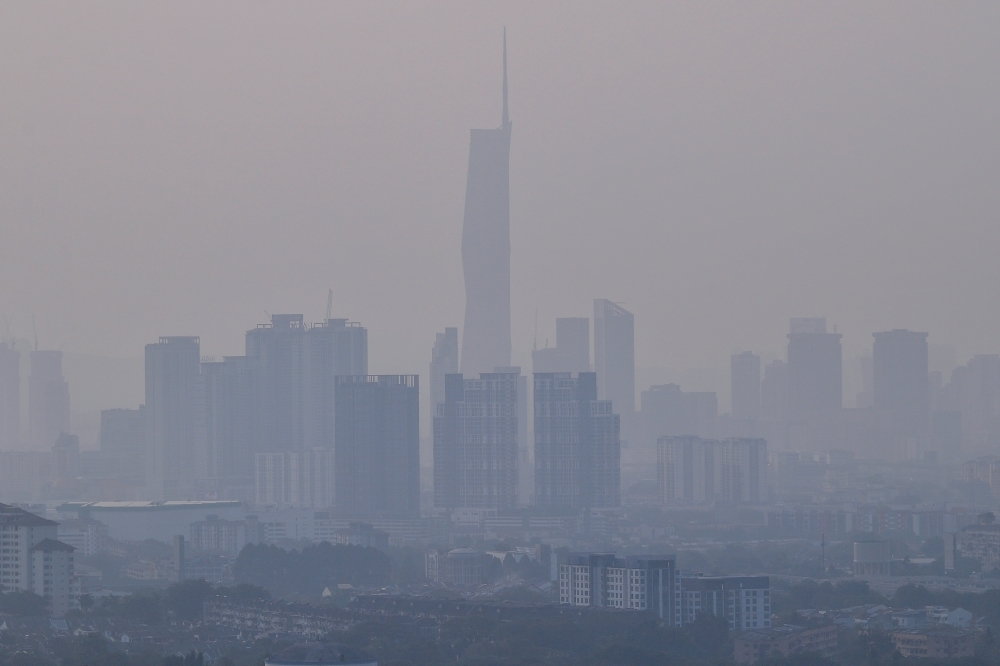
KUALA LUMPUR, Sept 25 — While public health warnings during haze episodes typically focus on respiratory health, medical experts are sounding the alarm on the hidden, often overlooked impact of pollutants on the body’s largest organ: the skin, as well as the scalp and eyes.
As air quality fluctuates, experts told Malay Mail that fine particulate matter, known as PM2.5 — particles measuring 2.5 micrometres in diameter — poses a significant risk that goes far beyond surface-level dirt.
According to UM Specialist Centre consultant dermatologist Dr Nik Aimee Azizah Faheem, these tiny particles are insidious.
“Haze is not just the usual dust and pollutants; it has PM2.5 particles which are tiny, 2.5 micrometres in diameter. These particles can penetrate our tissue, be it the skin, lungs, or eyes.
“They don’t just sit on the surface and cause external dirt,” she said.
The invisible damage
When PM2.5 particles infiltrate the pores, they disrupt the skin’s natural barrier.
This leads to increased sensitivity, dryness, and irritation, often triggering flare-ups of underlying conditions such as eczema, psoriasis, and acne.
However, the damage extends deeper.
Dr Kwan Zhenli, a consultant dermatologist and dermatologic surgeon at Subang Jaya Medical Centre, said haze consists of particulate matter from smoke, dust, moisture and vapour suspended in the air that impairs visibility.
“Particulate matter in haze can penetrate the skin, causing oxidative stress and inflammation.
“Haze also alters the skin microbiome composition, which can impair the skin’s barrier function. Air pollutants synergise with UV radiation to worsen oxidative skin damage, as pollution-related changes to the ozone layer allow greater UV transmission to the earth’s surface,” Dr Kwan explained.
This synergistic effect is a major point of concern for dermatologists, who note that many people falsely assume that “cloudy” or hazy skies mean lower UV exposure.
“Many omit their sun protective measures like wearing sunscreen, protective hat, sunglasses and UV-protective clothing, thinking that there is a lack of these harmful UV rays.
“This can lead to long-term photo-damaging effects like pigmentary disorders, wrinkles, and potentially skin cancers,” Dr Nik warned.
Echoing similar sentiment, Pantai Hospital Cheras dermatologist Dr Low Dyoi-E, said the consequences are chronic.
“Prolonged exposure may accelerate premature skin ageing by promoting free-radical damage to collagen and elastin.
“It can also contribute to dullness, uneven pigmentation and weakening of the skin barrier, increasing dryness and potentially aggravating inflammatory conditions such as eczema,” Dr Low said.
Scalp and hair health
The scalp is equally vulnerable.
The PM2.5 particles can block hair follicles, leading to inflammation and scalp congestion.
“On the scalp, these particles can also penetrate and block our hair follicles.
“This can lead to a disruption in our scalp barrier, a buildup of dirt and dead skin cells, as well as an overgrowth of Malassezia furfur, which is a type of yeast that is a normal commensal of our scalp,” said Dr Nik Aimee, adding that this may result in inflamed, itchy, flaky scalp called seborrhoeic dermatitis.
Dr Kwan added that for hair, “particulate matter can trigger inflammatory responses in the hair follicle, causing chemical and oxidative damage that leads to loss of shine, structural weakening and hair loss, including conditions such as alopecia areata.”
Vulnerability of eyes and children
The eyes are also immediate targets for haze-related irritation.
In the short term, exposure leads to dryness, redness, itchiness, and conjunctivitis.
Persistent exposure, however, can be more serious.
“Long-term effects can be in the form of persistent dry eyes, cataract and glaucoma,” Dr Nik Aimee stated.
Children are particularly at risk, given that they are generally more active and have developing immune and respiratory systems.
Dr Kwan emphasised that children are “more susceptible to the effects of haze as they typically spend longer time outdoors, are more physically active, and have developing respiratory systems that are more vulnerable to the effects of particulate matter.”
When should you worry?
While daily precaution is advised, there are specific thresholds for concern.
Dr Nik Aimee noted that for those with pre-existing skin, hair, or eye conditions, an Air Pollutant Index (API) of 50 and above may trigger a flare-up.
For the general population, an API of 100 and above is sufficient to cause dryness and irritation.
Steps to protect yourself
The experts advised a multi-pronged approach to mitigation, starting with the most effective method: avoidance.
“Number one is avoidance; that means to stay indoors and avoid any outdoor activities,” said Dr Nik Aimee.
She also advises avoiding wearing contact lenses, which can trap particles against the eye, and reducing screen time to prevent eye strain and further dryness.
Dr Kwan suggested a comprehensive routine: “Stay indoors as much as possible, use air purifiers, drink plenty of water, and eat a healthy diet rich in antioxidants.”
For skincare, Dr Low suggested using moisturisers containing ceramides, hyaluronic acid or niacinamide, and using antioxidants like vitamin C, vitamin E and niacinamide to help counter oxidative stress.
Both Dr Nik Aimee and Dr Low stressed the necessity of daily sunscreen, regardless of how hazy the sky appears.
“Wash the face and scalp after outdoor exposure; avoid harsh scrubbing,” advised Dr Low.
Date: 25 September, 2026 7:00 am
Source: Malay Mail
💬 Join the Conversation! 💬
We’ve disabled comments on our posts and pages to keep the discussions organized and lively! But don’t worry – the conversation isn’t over. Head over to our forum and share your thoughts, ideas, and feedback with the community! It’s the perfect place to connect, learn, and engage with others who care about the same things. We can’t wait to hear from you!