
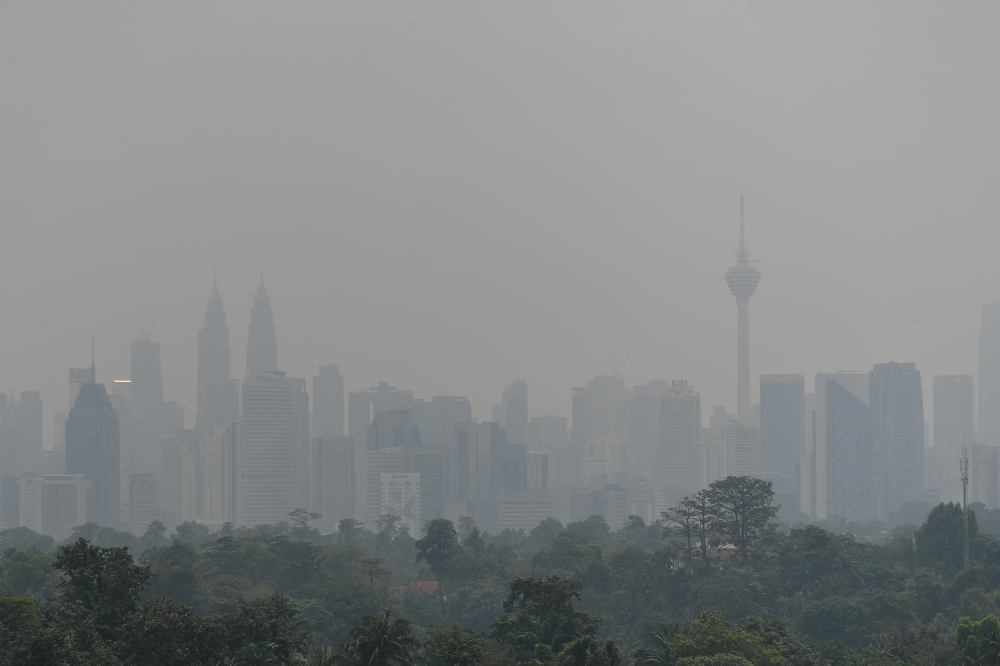
KUALA LUMPUR, Aug 12 — Malaysia has been experiencing haze since Aug 8, with 11 air monitoring stations recording unhealthy Air Pollutant Index (API) readings and one station in Sarawak recording a very unhealthy reading as of 3pm today, the Ministry of Natural Resources and Environmental Sustainability (NRES) said.
In a statement today, the ministry said the El Niño phenomenon occurring alongside the Southwest Monsoon had resulted in several areas, particularly southern Peninsular Malaysia and western and southern Sarawak, receiving below-average rainfall.
The combination of lower rainfall and higher temperatures could increase the risk of water shortages, forest and peat fires, as well as haze, particularly in areas experiencing prolonged dry conditions, it said.
As of 3pm today, 11 of the 68 air quality monitoring stations recorded unhealthy API readings. These were Cheras in Kuala Lumpur (122), Putrajaya (121), Shah Alam in Selangor (112), and in Sarawak, Miri (152), Samalaju (120), Bintulu (154), Sibu (135), Sarikei (161), Sri Aman (158), Samarahan (177) and Kuching (177).
The Sarawak station at Serian recorded a very unhealthy API reading of 204.
NRES said the deterioration in air quality in Sarawak was caused by transboundary haze as well as local fires at a waste disposal site under the supervision of the Sibu Municipal Council, covering an estimated 1.5 hectares, and forest and bush fires in Sri Aman covering about 100 hectares. Firefighting operations were ongoing at both locations.
Based on the Regional Haze Map and information issued by the Asean Specialised Meteorological Centre (ASMC) today, dry conditions were observed across southern Asean, except in parts of northern Sumatra where rain was reported.
Isolated hotspots were detected in central and southern Sumatra, as well as southern and eastern Kalimantan, with several hotspots also detected in Peninsular Malaysia, Sarawak, Java and Sulawesi.
Moderate smoke plumes were observed in West Kalimantan and Central Kalimantan, while light smoke plumes were observed in southern Sumatra.
Based on NOAA-20 satellite monitoring on Aug 11, 12 hotspots were detected in Malaysia, comprising one in Pahang and 11 in Sarawak. A total of 60 hotspots were detected in Sumatra and 354 in Kalimantan.
Dry weather is expected to continue across most of southern Asean, except northern Peninsular Malaysia and Sumatra, where rain is forecast. Prolonged dry conditions could lead to an increase in hotspots and haze, raising the possibility of transboundary haze, NRES said.
At the Asean level, Alert Level 2 was activated on Aug 3. Countries in southern Asean — Brunei, Indonesia, Malaysia, Singapore, Thailand and Timor-Leste — are required to submit daily reports and emergency responses on fires, haze and measures taken.
NRES, together with the Department of Environment and Malaysian Meteorological Department, will continue monitoring and reporting developments in the weather, air quality and haze situation.
Relevant ministries, departments and agencies will also implement measures outlined under the National Haze Action Plan and National Open Burning Action Plan based on the alert level.
Members of the public in affected areas are advised to reduce outdoor activities, wear face masks and drink sufficient water to stay hydrated.
Open burning is also prohibited to prevent the haze situation from worsening.
Date: 12 August, 2026 6:00 pm
Source: Malay Mail
💬 Join the Conversation! 💬
We’ve disabled comments on our posts and pages to keep the discussions organized and lively! But don’t worry – the conversation isn’t over. Head over to our forum and share your thoughts, ideas, and feedback with the community! It’s the perfect place to connect, learn, and engage with others who care about the same things. We can’t wait to hear from you!