
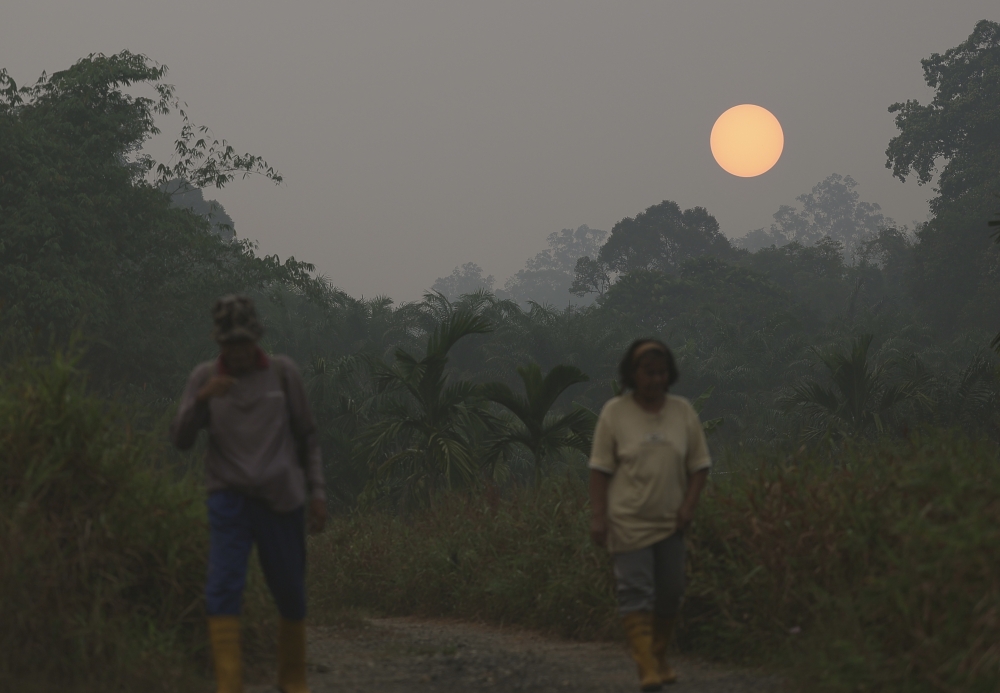
KUALA LUMPUR, Sept 1 — Small-scale burning activities such as burning rubbish, leaves and dry branches in residential yards, which are often considered trivial, can contribute to local air pollution, experts said.
Universiti Malaysia Kelantan Faculty of Earth Sciences lecturer Prof Dr Aweng Eh Rak said open burning, even on a small scale, can cause smoke to accumulate in a particular area, thereby increasing the concentration of smoke there.
“Open burning does not have a chimney to channel the smoke into the air, so harmful smoke becomes concentrated in one area and its concentration is high. This is more dangerous than smoke that is released into the air through a chimney,” he told Bernama.
Aweng said that during haze conditions such as those currently affecting the country, open burning could further increase the concentration of pollutants in an area, particularly when air circulation is poor.
“Villages usually do not have good air circulation, with airflow confined to the area. Under the current haze conditions, open burning will further increase the concentration of pollutants in the area,” he said.
Among the main pollutants produced by open burning are particles measuring 10 micrometres or less in diameter (PM10) and particles measuring 2.5 micrometres or less (PM2.5), he said.
He said organic waste such as leaves and branches should not be burned. Instead, they can be turned into compost, used as mulch to retain moisture in planting beds, or cut into small pieces and left to decompose naturally.
Meanwhile, Universiti Kebangsaan Malaysia (UKM) Institute for Climate Change director Prof Dr Mohd Talib Latif said local sources of pollution still need to be controlled even though a large proportion of the pollutants contributing to the current haze originate from transboundary sources.
He said an estimated 80 per cent of pollutants during haze episodes are believed to originate from peatland fires and transboundary air movement, while local sources also contribute, particularly when atmospheric conditions are stable.
He said haze conditions are also influenced by meteorological factors such as wind speed and direction, temperature, rainfall and humidity, as well as geographical features of the earth’s surface.
Haze conditions can be forecast based on the number of hotspots and wind movement, he said.
Mohd Talib said this is why the Department of Environment is constantly stepping up enforcement and conducting daily patrols in areas at risk of open burning, while also monitoring Air Pollutant Index readings from time to time.
According to Mohd Talib, the Malaysian Meteorological Department, in collaboration with UKM researchers, has developed the Malaysia Community Multi-scale Air Quality Model (MyCMAQ) to help forecast air quality.
Mohd Talib also said the use of vehicles, particularly in major cities, as well as energy generated from combustion sources, also contributes to local air pollution. — Bernama
Date: 1 September, 2026 10:15 am
Source: Malay Mail
💬 Join the Conversation! 💬
We’ve disabled comments on our posts and pages to keep the discussions organized and lively! But don’t worry – the conversation isn’t over. Head over to our forum and share your thoughts, ideas, and feedback with the community! It’s the perfect place to connect, learn, and engage with others who care about the same things. We can’t wait to hear from you!