
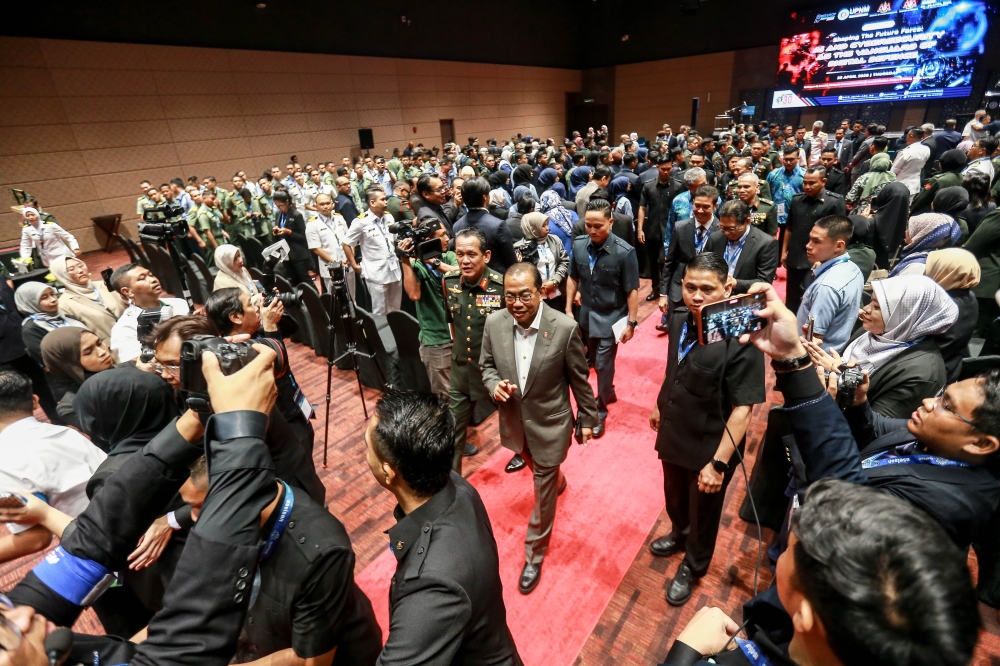
KUALA LUMPUR, April 23 — Some of the most lethal security threats today do not necessarily come in the form of missiles and heavy artilleries.
Instead, malicious actors now deploy threats in the form of cyberattacks, sabotages targeting critical national infrastructures and relentless disinformation campaigns.
Malaysia took cognisant of the changing reality from early on.
The Malaysian Armed Forces (MAF) formally adopted Cyber Electromagnetic Activities (CIMA) as Malaysia’s fourth defence domain — on par with land, sea and air — in its Defence White Paper.
Taking the initiative forward, Universiti Pertahanan Nasional Malaysia (UPNM) hosted a forum today, aimed at tackling emerging security threats confronting Malaysia.
Themed “Shaping the Future Force: AI and Cybersecurity as the Vanguard of Digital Defence”, the forum revolved on the necessity for Malaysia to develop a future-ready and resilient defence ecosystem.

Building a future-ready force
Speaking at the forum today, Defence Minister Datuk Seri Mohamed Khaled Nordin said Malaysia is currently developing a Cyber and Electromagnetic Command (PSEP) that aligns with the Malaysian Defence Intelligence Organisation (MDIO) to create a real-time, data-driven intelligence ecosystem.
Khaled said doing so will grant information superiority and dominance to Malaysia, which is a powerful edge in asymmetric modern warfares.
“The future of warfare is increasingly asymmetric,” Khaled said in his opening remarks at the forum held in conjunction with the Defence Services Asia (DSA) and National Security Asia 2026 exhibition.
“Power is now defined by adaptability and innovation.
“True national defence combines advanced technology with human judgement.
“By 2030, we aim to fully integrate our concepts, systems, and operations — enabling every component to operate as one unified, effective force,” he added.
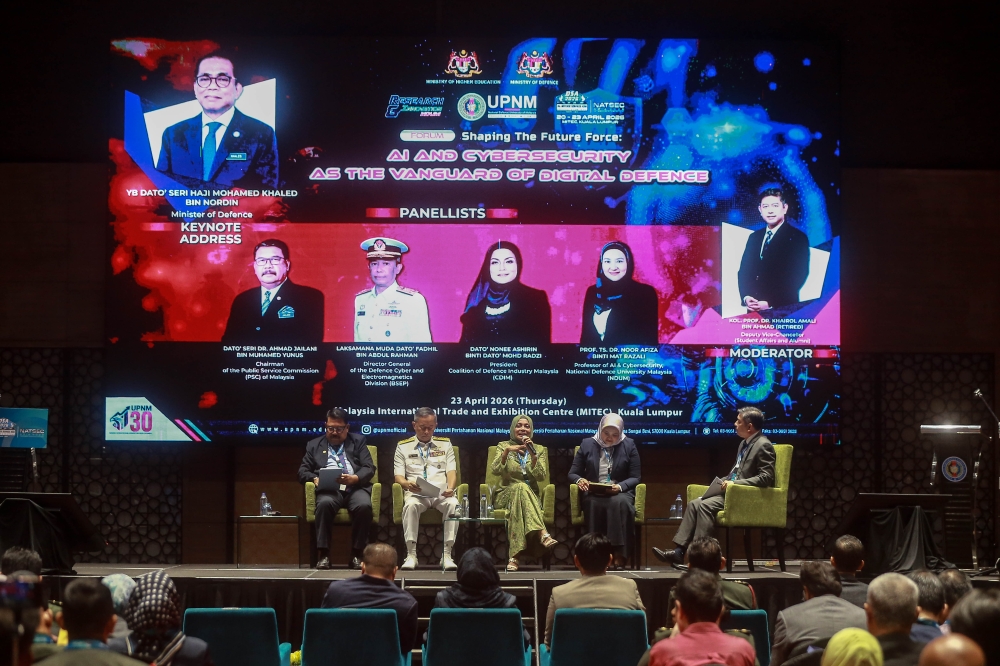
Invest in human capital, drive local innovation
Defence capabilities do not solely rely on machinery and weapons. Nurturing human capital that adapts to the ever-evolving threats is also necessary.
Khaled, therefore, called on institutions like UPNM to be at the forefront in producing homegrown talents to helm the country’s defence in an increasingly volatile world.
“We must invest in human capital, our people. Cyber defence requires highly skilled professionals.
“Institutions like UPNM must produce leaders who master artificial intelligence (AI) and cybersecurity, while understanding the strategic and ethical dimensions.
“Technology must be guided by both wisdom and purpose,” he added.
Khaled said the Defence Ministry is also establishing the Cyber Security and Geospatial Specialist Regiment within the Askar Wataniah (Territorial Army).
This initiative, he said, aims to encourage skilled youth and professionals from the private sector to bolster Malaysia’s digital defence ecosystem.
Driving local innovation also remains a national priority for Malaysia, in line with the National Defence Industry Policy.
A key strategic priority for its national digital defence also include development of sustainable local defence capabilities and reduce reliance on foreign assets.
Khaled said homegrown talents must go on to develop sovereign technologies and reduce the reliance for defence capabilities from external sources.
The country, he said, could also leverage on its critical mineral resources to embed itself in the global digital supply chain in this aspect.
Concerted effort needed
The UPNM forum also echoed the need for whole-of-government and whole-of-society approaches to bolster Malaysia’s digital defence capabilities.
Khaled said Malaysia’s cyber defence ecosystem requires cohesive cross-agency cooperation between government, industry, and academia.
“Our readiness must be consistent and proactive, shared across all sectors of society — not just the Armed Forces,” he said.
The responsibility now rests on UPNM, the country’s sole defence university, to shape strategic dialogues and cross-collaborations that can ultimately redefine Malaysia’s defence landscape.
Date: 23 April, 2026 7:05 pm
Source: Malay Mail
💬 Join the Conversation! 💬
We’ve disabled comments on our posts and pages to keep the discussions organized and lively! But don’t worry – the conversation isn’t over. Head over to our forum and share your thoughts, ideas, and feedback with the community! It’s the perfect place to connect, learn, and engage with others who care about the same things. We can’t wait to hear from you!