
KUALA LUMPUR, Oct 11 — For a patient visiting a hospital where electronic medical records are already in use, much of the paperwork that has traditionally accompanied a trip to a government hospital can now happen behind a screen.
Registration is recorded electronically, appointments are managed through the hospital’s information system, and doctors can retrieve a patient’s medical information without having to wait for a physical folder to arrive from another department.
The idea behind an electronic medical record (EMR) is straightforward: instead of a patient’s medical history being stored primarily in paper files, the information is recorded and managed digitally, allowing authorised healthcare personnel to retrieve it when needed.
But Malaysia is still in the process of making that transition across its public healthcare system.
For patients who continue to encounter paper-based processes, the contrast between the two systems can sometimes be stark.
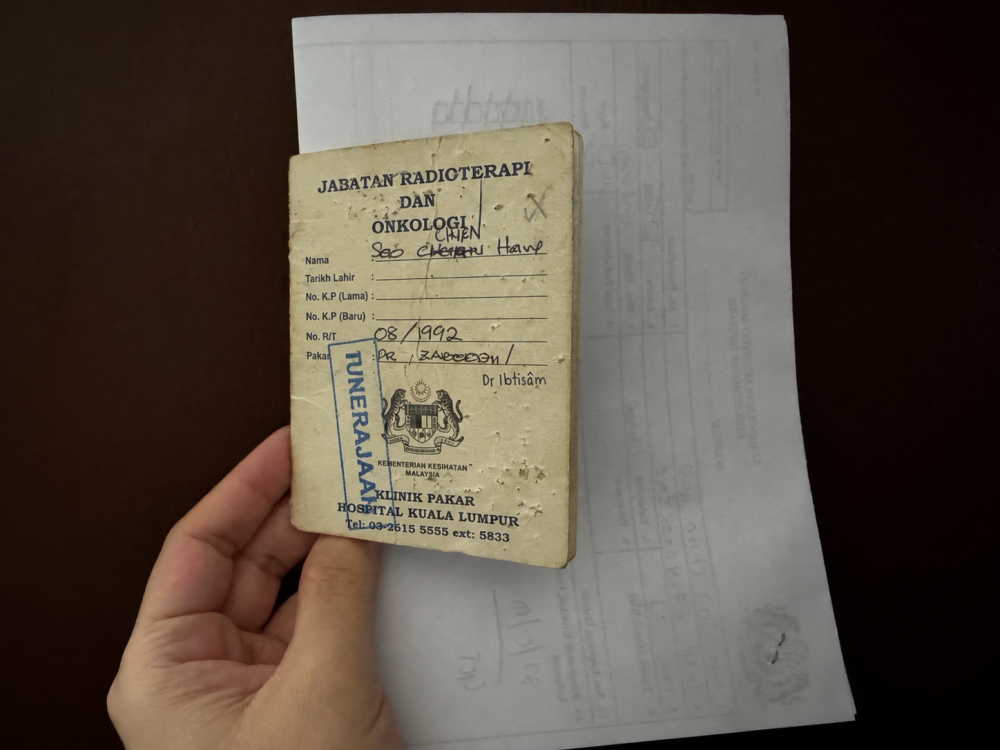
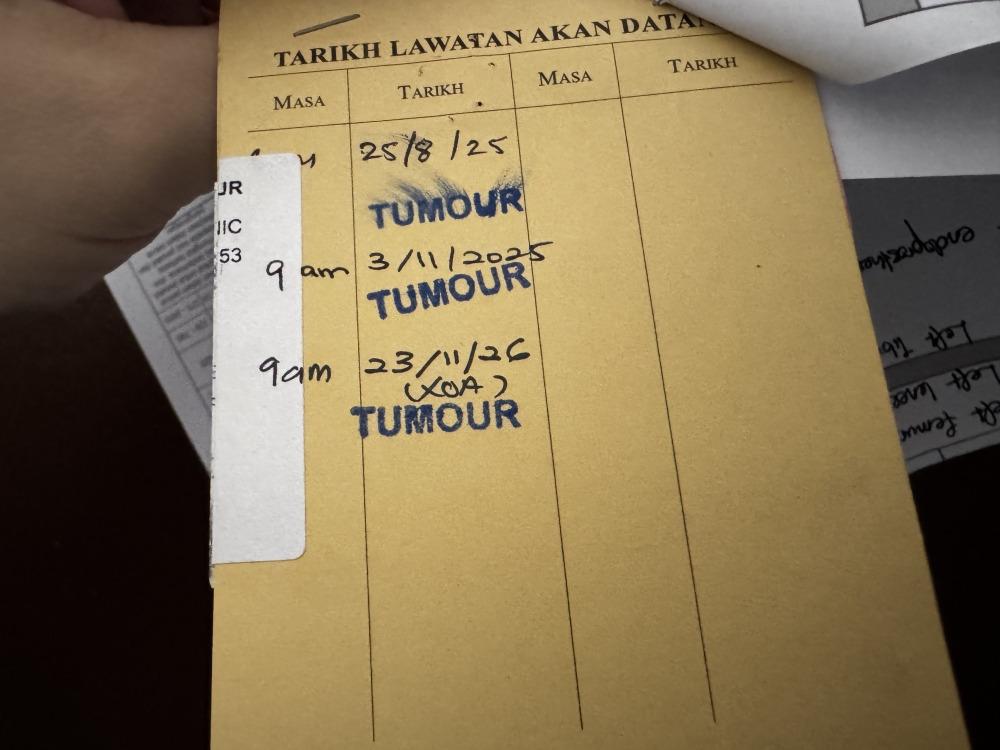
Jensen Lim, 38, recalled how his paper appointment book was once drenched in water, creating problems when he needed to arrange his next appointment.
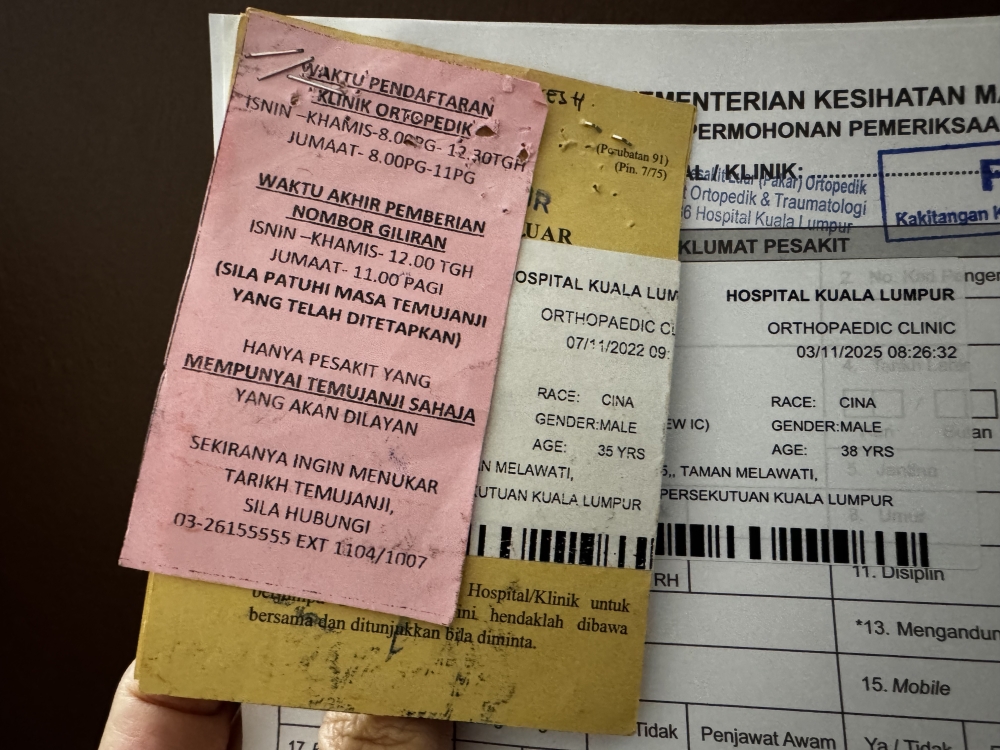
“If you forget to bring the appointment book, you can’t get an appointment or even change the date of an existing appointment.
“Even a surgery appointment was dependent on a cardboard appointment slip,” Lim said when contacted by Malay Mail.
At an orthopaedic department, another patient who had suffered a dislocated and fractured shoulder said she was made to wait about two hours while a nurse searched for her medical file.
CK Tan, 70, said the hospital was eventually unable to locate it.
“I cannot comprehend how they lost such a thick file (about one inch).
“The doctor had to retrace my recovery process and what treatments I had undergone leading up to the present follow-up in order to plan for my next rehabilitation steps,” Tan told Malay Mail.
At an oncology department in northern Malaysia, another patient had a similar experience.
Her medical report containing biopsy results went missing, leaving her facing the possibility of having to undergo another procedure.
The file was eventually located several days later after efforts were made to find it.
“I was told that they misplaced my files, which I felt was appalling, given that it was not just a simple cough or flu illness I had,” said Medaline Chong, 60, who was diagnosed with leukaemia.
The inconvenience is not limited to hospital records.
At a dental clinic, Rahimah Mohd Razman, 35, said registration still involves dropping a paper appointment card into a designated box to join the queue.
Patients are now required to make appointments through the MySejahtera mobile application.
While this may sound more efficient, Rahimah said she was unable to choose the clinic where her dental records were kept because there were no appointments available there in the near term.
“I was in too much pain, and the next available slot for that particular clinic was in two months’ time.
“So I resorted to whichever clinic had the closest available slot.
“Because they had no access to my dental records, I had to rely on a photo I took of my tooth’s X-ray for the dentist to understand my case (a follow-up treatment),” Rahimah said.
These are individual experiences and do not suggest that every government hospital or clinic operates this way.
But they illustrate the practical problem EMR is intended to address: ensuring that a patient’s medical information can be retrieved when and where it is needed, without depending on the movement and storage of physical files.
What exactly is an EMR?
An EMR is more than a scanned copy of a paper file.
Currently, the Health Ministry’s hospital information system, HIS@KKM, covers areas including registration, appointments, admissions and medical-record management, as well as clinical documentation across different disciplines.
Other systems support specific areas of care, such as laboratory, pharmacy and radiology services.
This matters because Malaysia’s digital healthcare infrastructure was not built as a single nationwide database.
Different systems were introduced at different times and for different parts of the healthcare system.
Why are hospitals still using paper files?
While electronic records have existed in parts of the public healthcare system for years, not all facilities use the same system, and not all systems are connected.
For example, TPC-OHCIS uses a centralised database and allows records to be accessed by participating facilities using the system. It can also integrate with laboratory, pharmacy and radiology systems, as well as MyHIX, the Malaysian Health Information Exchange.
Hospital systems, meanwhile, have developed along a separate track, with HIS@KKM and specialist systems such as the Radiology Information System (RIS) and Picture Archiving and Communication System (PACS) being expanded at different facilities.
Introducing digital systems does not necessarily mean that every document generated during a patient’s treatment immediately becomes electronic.
Hospital Cyberjaya, for example, operates HIS@KKM, but according to the Selangor Health Department, some medical-record documents still remain outside the system and continue to be managed in physical form.
That reflects a wider challenge: a hospital can have a digital core while some documents, older records or other systems remain outside it.
What is the government doing now?
The latest push is backed by an additional RM350 million, bringing the allocation for public healthcare digitalisation to RM1 billion.
The wider initiative involves 150 hospitals and 2,000 health clinics nationwide, and includes accelerating EMR implementation and improving internet connectivity at public healthcare facilities.
Health Minister Datuk Seri Dzulkefly Ahmad said the additional allocation would allow the ministry to speed up EMR implementation and expand the use of digital medical systems.
He said the initiative was expected to improve efficiency, reduce waiting times, improve the patient experience and ease congestion at healthcare facilities.
Communications Minister Datuk Seri Fahmi Fadzil said 15 government hospitals were among the initial group expected to benefit, while efforts would be made to increase the number of hospitals and clinics covered.
How Malaysia ended up with multiple digital systems
Malaysia’s move towards digital public healthcare has been more than two decades in the making.
The broader Hospital Information System (HIS) programme was developed in 2002, with modules covering areas including electronic medical records and clinical documentation, patient management, radiology, laboratory, pharmacy and critical care.
Primary healthcare followed a different path.
The Teleprimary Care (TPC) system was introduced in 2005, while the Oral Health Clinical Information System (OHCIS) dates to 2009.
The two were later integrated into TPC-OHCIS, which was piloted in Seremban in 2017.
The Health Ministry describes TPC-OHCIS as an electronic medical record system used at participating primary healthcare facilities, with a centralised database that allows records to be accessed across facilities using the system.
According to the ministry’s 2011 annual report, development of HIS@KKM was about 90 per cent complete that year, with full development then expected by July 2012 before implementation at Hospital Raja Permaisuri Bainun in Ipoh.
In November 2025, the Health Ministry said it was targeting all 150 public hospitals and more than 3,000 primary healthcare facilities nationwide to be equipped with EMR systems by 2029.
Health Ministry’s EMR timeline
The broader effort is intended to support a more connected health-record system, an aspiration the Malaysian Communications and Multimedia Commission described in August 2026 as “One Individual, One Record”.
The result is a healthcare system in which digital tools are already widely used in some settings, but have been introduced at different times and for different purposes.
The challenge now is not simply to add more digital systems, but to ensure they can work together across facilities and levels of care.
Can a patient’s medical record follow them?
One of the goals of a national EMR is to establish the basis for a Lifetime Health Record, facilitate follow-up care at a healthcare facility closer or more convenient to the patient, and reduce repeated laboratory and radiology investigations.
In simple terms, the aim is for the medical record to follow the patient, rather than the patient having to follow the physical record.
What changes for patients?
As the systems become more connected, some changes could be relatively simple from a patient’s perspective.
Patients may no longer have to depend on carrying a physical appointment book, while a doctor at a participating facility could potentially retrieve relevant information from previous treatment instead of waiting for a physical file.
But the bigger change is not simply getting rid of paper.
Malaysia has spent more than two decades building different pieces of a digital healthcare system.
The next stage is making those pieces work together.
Date: 11 October, 2026 7:30 am
Source: Malay Mail
💬 Join the Conversation! 💬
We’ve disabled comments on our posts and pages to keep the discussions organized and lively! But don’t worry – the conversation isn’t over. Head over to our forum and share your thoughts, ideas, and feedback with the community! It’s the perfect place to connect, learn, and engage with others who care about the same things. We can’t wait to hear from you!