
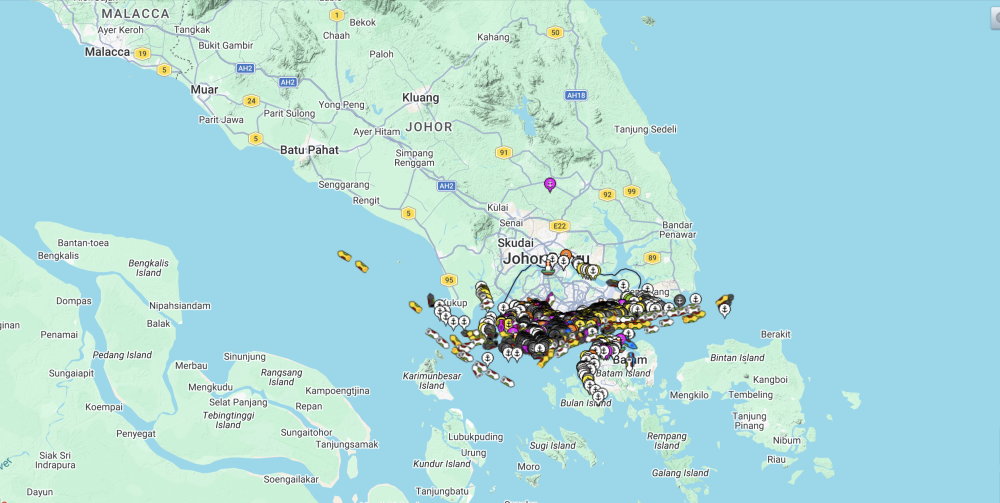
KUALA LUMPUR, May 22 — The head of a waste management consultancy has warned that Malaysia must impose a stricter maritime waste management system to protect the Strait of Melaka from environmental pollution, as shipping traffic is set to increase significantly through the passageway.
This is in view that the incidence of oil spills can increase as more vessels ply between Europe and Asia and are redirected through the strait as an alternative route to avoid the conflict-stricken Strait of Hormuz, said Nur Zulaikha Yusof, head of sustainability and strategic planning at Hexagon Synergy Group.
She also said there should be coordination between Malaysia, Singapore and Indonesia, which share the Strait of Melaka waterway, to ensure effective enforcement.
“Vessel volume is projected to increase by between 10 and 20 per cent as more shippers seek an alternative route between Europe and Asia,” she told Bernama recently.
As a result, there is a likelihood of increased oil spills as well as other incidents.
This could expose the strait to greater environmental danger which could adversely affect the marine ecosystem and the livelihood of fishermen.
Nur Zulaikha recounted how in just eight years between 2014 and 2022, there were an alarming 130 oil spills along the Strait of Melaka. “Accommodating more redirected vessels here makes the Strait of Melaka vulnerable.”
She said the efficiency of the straits, including the Strait of Melaka, stemmed from their role in connecting Middle Eastern supply with East Asian demand. “Yet this advantage comes at a cost: the corridor is narrow, congested, and environmentally fragile.”
While the recalibrating situation allows the Strait of Melaka to absorb the spillover traffic, it also creates a familiar paradox for Malaysia—greater strategic relevance accompanied by higher environmental exposure.
Rising shipping pressure, environmental risks
More recently, the Malaysian Maritime Enforcement Agency (MMEA) identified 39 cases of illegal bilge discharge and unauthorised ship-to-ship transfers between 2021 and April 2026, often involving foreign-flagged vessels.
These incidents underscore why the Strait of Melaka is not only heavily utilised, but also increasingly vulnerable, she said.
Its geography magnifies risk as dense traffic funnels through narrow channels, often in proximity to coastlines and fishing grounds.
This being the case, the environmental stakes are high and rising and will disrupt fisheries and the livelihood of fishermen who depend on a clean and stable marine ecosystem.
New forms of pollution are also entering the equation, she said, adding that a 2021 study by the International Council on Clean Transportation identified the Melaka Strait as one of the world’s largest scrubber washwater hotspots, alongside regions in Europe and the Caribbean, with more than 180 million tonnes discharged annually.
Scrubber washwater is the contaminated water byproduct generated by marine exhaust gas cleaning systems (scrubbers) used to remove sulphur and other pollutants from ship engine exhausts.
“While Malaysia has banned open-loop scrubber discharge within port limits, enforcement beyond those boundaries remains difficult, allowing pollutants to accumulate in adjacent sea lanes,” she said.
Nur Zulaikha also said that any sustained disruption in the Gulf, whether in the Strait of Hormuz or the Red Sea, will push more traffic through Southeast Asia. Scenario assessments suggest vessel volumes could rise by 10–20 per cent.
“That may sound manageable on paper but in reality, it compounds pressure on already strained systems such as ports, anchorages and critically, waste management infrastructure,” she said.
Nur Zulaikha highlighted that challenges remain in the operational structure of Malaysia’s ship-generated waste management system.
“Malaysia relies heavily on the Department of Environment-licensed contractors to handle ship-generated waste.
“While the number of contractors is not insignificant, their operational scope is limited. They cannot always accommodate the full range of the International Convention for the Prevention of Pollution from Ships (MARPOL) Annex waste streams, and they operate within constraints on permissible volumes and waste types,” she said.
She said the result is predictable—delays, bottlenecks and a system that falls short of the International Maritime Organisation’s (IMO) own definition of “adequate”.
Call for stronger governance
She said enforcement must move from reactive to preventive, supported by better surveillance and consistent prosecution.
Port reception facilities need to be treated as core infrastructure, not ancillary services, and should be expanded, standardised and priced in a way that encourages use rather than avoidance.
Additionally, regulation must also keep pace with emerging pollutants such as scrubber discharge, ideally in alignment with regional partners “because this is not a problem that Malaysia can solve alone,” she said.
The Strait of Melaka is shared with Indonesia and Singapore and pollution does not recognise maritime boundaries. “Coordination in monitoring, enforcement and standards is essential,” she said.
Malaysia is approaching a strategic inflection point whereby increased traffic through the strait could strengthen its position as a maritime hub.
“But without the right safeguards, it could just as easily erode environmental integrity and regulatory credibility,” she added. — Bernama
Date: 22 May, 2026 8:00 am
Source: Malay Mail
💬 Join the Conversation! 💬
We’ve disabled comments on our posts and pages to keep the discussions organized and lively! But don’t worry – the conversation isn’t over. Head over to our forum and share your thoughts, ideas, and feedback with the community! It’s the perfect place to connect, learn, and engage with others who care about the same things. We can’t wait to hear from you!