
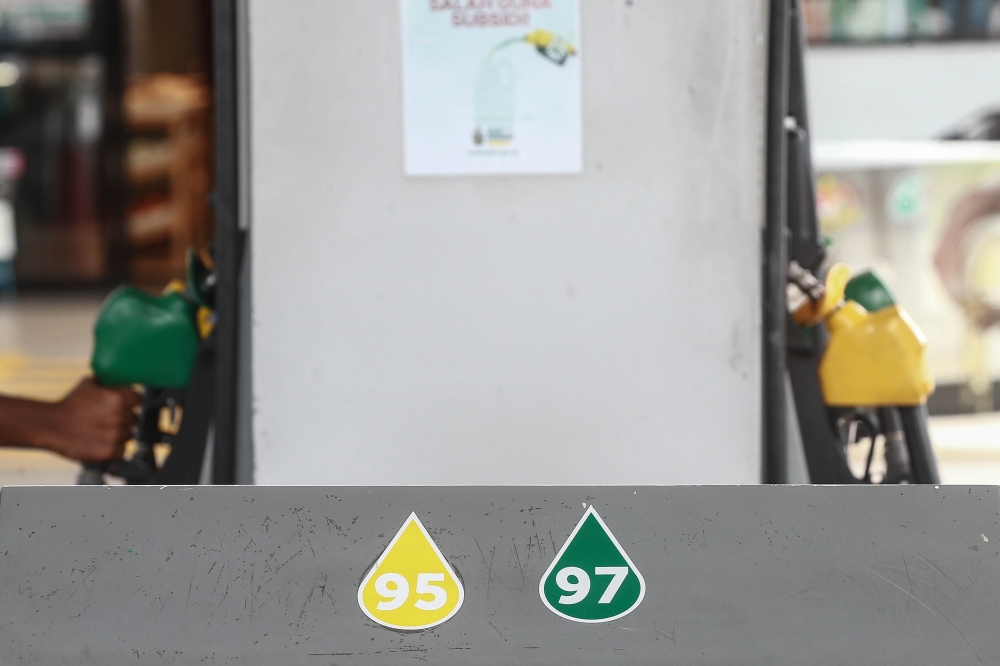
PUTRAJAYA, Sept 6 — Malaysia’s fuel supply remains stable despite lower global supply levels, with the government confident it can secure sufficient supplies through to the end of the year, said the prime minister’s economic adviser Nurhisham Hussein.
Nurhisham, who also heads the Secretariat of the National Economic Action Council (MTEN) Crisis Management Task Force, said the global fuel situation has remained fluid. Risks, however, remained skewed towards higher prices due to geopolitical tensions and disruptions to key shipping routes, he added.
Malaysia is a major importer of crude oil but is a net exporter of liquefied natural gas (LNG).
Global oil supplies have been severely affected due to the West Asia conflict, which erupted in February and has shown no signs of ending, with continued attacks between the United States and Iran till today.
Nurhisham reckons that countries are likely to rebuild their oil reserves only when prices returned to more reasonable levels of around US$80 per barrel.
“So, we will have a very slow rebuilding of reserves by these countries, but that implies as well that over the next two to three years oil prices will continue to be elevated. It might not shoot up, but it will continue to be elevated. It’s still a very fluid situation as far as fuels are concerned,” he told a media briefing on the global supply crisis on Friday.
The economic adviser noted that the Suez Canal and Bab-el-Mandeb have remained open despite continuing threats, while damage to Russian facilities and the United States’ blockade of Iranian exports are among factors that could affect global oil supplies. He said the depletion of reserves would eventually remove one source of supply and that would add to uncertainty in the global energy market.
During the one-hour briefing, Nurhisham also shared that China’s rapid adoption of electric vehicles (EVs) was helping to moderate global oil demand and that there had been a significant increase in EV purchases among Chinese consumers. This had helped ameliorate oil demand, he noted.
“At the same time, Chinese refineries were operating at about 80 to 90 per cent capacity originally because of external demand, so they’re actually doing a lot of exports as well,” he said.
Global food outlook
On the global food outlook, Nurhisham said the latest reports indicated a strong El Niño that could persist into February 2027. He noted that Pacific Ocean temperatures in the El Niño-Southern Oscillation (ENSO) area were already about two degrees above normal.
“That’s already an indicator of a strong El Niño. It has not arrived here yet, and the UN office’s projection is that we’re probably looking at some time in October or November before we really start feeling it. It does feel like we’ve got El Niño already, but that will also have a significant impact around the world. It’s not just Southeast Asia. It’s South Asia, Central and Southern Africa as well, as well as the Caribbean and Latin America,” he added.
Nurhisham said the changing weather patterns are significant for Malaysia given its dependence on imports from some of these regions. Latin America is an important source of food-related feedstock while India is also a major trading partner for food inputs and food products.
Based on the latest Food and Agriculture Organisation (FAO) projections that he shared during the briefing, global rice supplies are expected to fall 1.6 per cent next year, and this comes against an estimated one per cent increase in demand.
Global stocks could therefore decline by about two per cent, he said, adding that wheat production was also expected to fall by 3.8 per cent, with some regions seeing up to 26 per cent declines, while maize production is projected to drop 2.7 per cent.
“On the flip side, soy is expected to continue to record numbers. So, it’s not all bad. Certain crops are going to do well, certain crops that will not do so well,” he said.
However, he cautioned that seasonal products such as vegetables and eggs could still see changes in supply and prices. For Malaysia, he said the overall food supply situation remained adequate, thanks to the supply which exceeded demand by about 10 per cent across most categories being monitored.
Fuel sufficiency
On Malaysia’s immediate supply position, Nurhisham said fuel sufficiency was guaranteed through the end of September. “Petronas is confident that we’ll be able to (have enough supply) through the end of the year (and) that they’ll be able to get supplies.”
As for “industrial materials and supplies, so far we have not had significant shortages, but certain small and medium enterprises have faced real supply shortages. But so far, whatever we require, we’ve been able to get, including things like plastics,” he revealed. The medical devices and medicines supply situation was also stable.
Nurhisham said fewer than half a dozen medicine categories were considered critical, with most having alternative remedies or medicines available. He cited antihistamines, where several alternatives were available in the market.
On inflation, Nurhisham said the overall situation remained relatively manageable at about two per cent annually and that food inflation was also broadly in line with the prevailing trend.
“Food inflation is roughly still in line with the trend. There are certain pockets where we’re seeing price increases, and there has been some fallout or pass-through from higher energy prices, especially diesel. But obviously, with the recent announcement on the increase in monthly allocation of the Budi Madani RON95, we’re hoping to be able to ameliorate that,” he continued.
The basic monthly eligibility limit under Budi Madani RON 95 has increased from 200 to 300 litres effective Sept 1 this year.
The Ministry of Finance said the adjustment covers Budi Madani RON95 and Budi Madani Diesel, with eligible recipients entitled to up to 300 litres monthly. The subsidised price remains RM1.99 per litre for RON95 and RM2.10 per litre for diesel under the respective schemes.
Nurhisham also said the government might need to accelerate some spending to fund critical infrastructure projects, including water and electricity generation projects, amid growing needs in these areas.
However, he said the government’s longer-term fiscal consolidation objective remains unchanged, with the deficit target still aimed at three per cent of gross domestic product.
“The target may have to be adjusted for the current year due to the need for additional spending, but the government does not expect further changes to the fiscal consolidation path from next year onward. This year, unfortunately, we had to move it. But next year (onward), it should not. There are certain ‘pockets’ where we’re seeing price increases,” he added. — Bernama
Date: 6 September, 2026 10:19 am
Source: Malay Mail
💬 Join the Conversation! 💬
We’ve disabled comments on our posts and pages to keep the discussions organized and lively! But don’t worry – the conversation isn’t over. Head over to our forum and share your thoughts, ideas, and feedback with the community! It’s the perfect place to connect, learn, and engage with others who care about the same things. We can’t wait to hear from you!