
KUALA LUMPUR, Sept 23 — Malaysia does not have a specific house-arrest law. Yet the Prisons Department already has powers that can, under certain conditions, allow prisoners to remain outside prison while their sentences are still running.
That distinction has come into focus after former prime minister Datuk Seri Najib Razak was granted a conditional pardon on September 18 allowing him to serve the remainder of his SRC International jail sentence under house arrest until August 23, 2028, subject to payment of a RM50 million fine and other conditions.
How does the arrangement work? What powers do the prison authorities already have, how is that different from a royal pardon, and what happens to Najib’s separate 1MDB sentence?
Here is a simplified guide based on the Prison Act 1995, the Prisons Regulations 2000, court judgments and news reports.
1. What were the terms of Najib’s September 18 conditional pardon?
Najib was granted a conditional pardon allowing him to serve the remainder of his SRC International jail sentence under house arrest until August 23, 2028, subject to payment of the RM50 million fine and compliance with other conditions.
If Najib breaches any of the conditions, the conditional pardon will be revoked and he must immediately serve the remainder of his sentence in prison.
The pardon does not mean Najib was immediately transferred home.
As of September 21, Attorney General Tan Sri Mohd Dusuki Mokhtar said Najib had yet to pay the RM50 million fine. Until that condition is fulfilled and the necessary process is completed, Najib remains in Kajang Prison.
2. Does Malaysia actually have a law specifically governing house arrest?
Short answer: No.
Home Minister Datuk Seri Saifuddin Nasution Ismail has said Malaysia does not yet have a specific law governing house arrest, although such legislation had previously been proposed for eligible remand detainees as part of efforts to reduce prison overcrowding.
The issue was also addressed by the High Court in December 2025, when then High Court judge Alice Loke ruled that an earlier order for Najib to serve his sentence under house arrest was invalid because it had not been deliberated or decided at the relevant Pardons Board meeting.
“In any event, I am of the view that a house arrest order is not capable of execution, there being no legal provision for such mechanism in Malaysia,” she said.
The judge also rejected Najib’s lawyers’ argument that Section 43 of the Prison Act could be used to implement that particular house-arrest order.
She said Section 43 gives prison authorities discretion over how long a prisoner may remain outside prison, whereas the disputed order specified how long Najib was to remain outside prison and restricted the authorities’ discretion to recall him to prison.
The judge nevertheless indicated that Najib could separately apply to the Prisons Department for release under Section 43.
3. So what power does the Prisons Department already have?
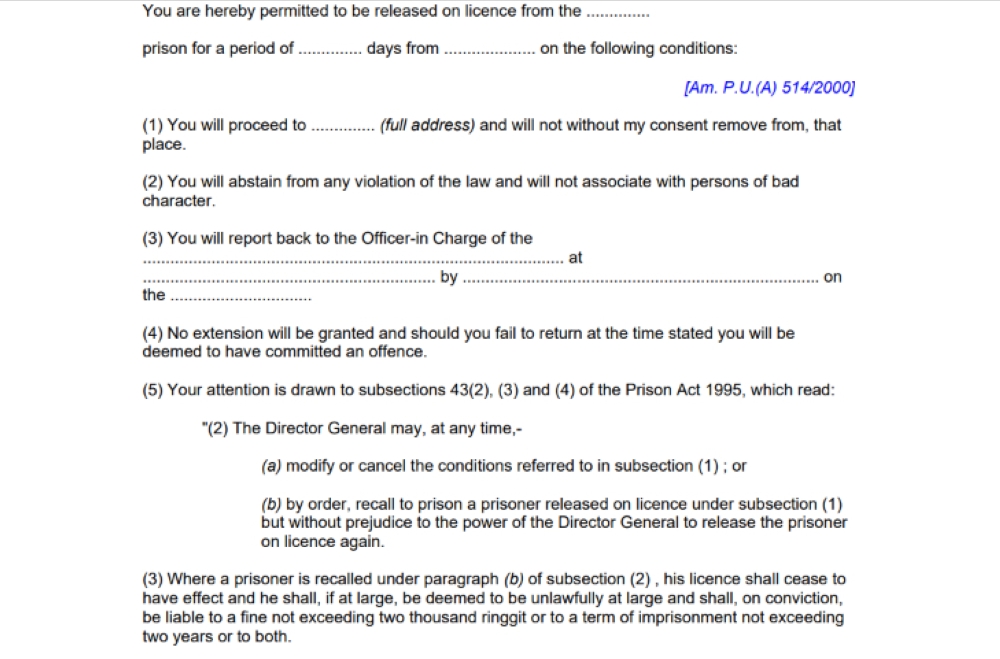
Under Section 43 of the Prison Act, the Commissioner General of Prisons may release a prisoner on licence and impose conditions on that release.
The release may be granted “at any time”.
If a prisoner fails to comply with any of the conditions imposed, they can face a maximum fine of RM2,000, a maximum jail term of two years, or both.
The Commissioner General may also modify or cancel the conditions of the licence, recall the prisoner to prison and subsequently release the prisoner on licence again.
In other words, release on licence provides a legal mechanism for a prisoner to remain outside prison while the original jail sentence is still running.
4. Could release on licence mean serving time at home?
Yes, potentially.
Under Regulation 111 of the Prisons Regulations 2000, the Commissioner General may release on licence a prisoner who has served at least four years of their sentence and impose conditions on that release.
That could potentially allow a prisoner to spend part of their sentence at home, if the Commissioner General specifies that as the place where they are required to remain.
The regulations do not spell out in detail other aspects of a prisoner’s life while released on licence, such as whether they may live with family members, receive visitors or communicate freely with people outside.
By comparison, the regulations contain detailed rules governing prisoners who remain in prison, including communication with relatives and friends, the frequency and duration of visits and the number of visitors permitted at one time.
Attorney General Mohd Dusuki said the Prisons Department is expected to issue standard operating procedures for Najib’s house-arrest arrangement, including rules covering visits, security and the monitoring of his movements.
5. Has Section 43 been used before?
During a High Court hearing on November 24, 2025, Najib’s lawyer Tan Sri Muhammad Shafee Abdullah claimed that Section 43 and Regulation 111 had previously been used to allow prisoners to spend periods of their sentences outside prison.
Shafee claimed the provisions had been used to allow Tun H.S. Lee’s grandson, Kenneth Lee Fook Mun — whose death sentence had been commuted to life imprisonment following a pardon — to serve the remainder of his jail term at home because his “aged father” was living there alone.
Shafee also argued before judge Alice Loke that Section 43 had been used to temporarily release a prisoner for a week to spend Hari Raya with his family, citing a June 4, 2019 news report titled “Kajang prison inmate gets to spend Raya at home with family”.
These were arguments put forward by Najib’s lawyer during the proceedings.
6. Who granted Najib the conditional pardon?
Short answer: The Yang di-Pertuan Agong.
His Majesty Sultan Ibrahim, King of Malaysia, granted the conditional pardon following the 64th meeting of the Pardons Board for the Federal Territories of Kuala Lumpur, Labuan and Putrajaya on September 18.
Under Article 42 of the Federal Constitution, the Agong has the power to grant pardons for offences committed in the Federal Territories.
The Agong presides over meetings of the Federal Territories Pardons Board and exercises his pardoning power in accordance with the constitutional process involving the board.
Before the board gives its advice, it is required to consider the Attorney General’s written opinion on the matter.
Based on news reports, the Federal Territories Pardons Board currently includes Attorney General Tan Sri Mohd Dusuki Mokhtar, Federal Territories Minister Hannah Yeoh and former Inspector-General of Police Tan Sri Razarudin Husain.
The announcement of Najib’s conditional pardon came from the Prime Minister’s Department’s Legal Affairs Division, or BHEUU, which serves as the Pardons Board’s secretariat.
7. What happened with Najib’s first SRC pardon and the earlier house-arrest order?
Najib has been in prison since August 23, 2022, after the Federal Court upheld his conviction in the SRC International case.
His original sentence was 12 years’ jail and a RM210 million fine.
In January 2024, his jail term was reduced to six years and his fine to RM50 million following a Federal Territories Pardons Board meeting.
The reduced sentence carried an official release date of August 23, 2028 if the RM50 million fine was paid, or August 23, 2029 if it remained unpaid.
A separate add-on or addendum order by the then Agong purportedly allowed Najib to serve the remainder of his sentence under house arrest.
But in December 2025, the High Court ruled that the addendum was constitutionally invalid because it had not been deliberated or decided at the Pardons Board meeting.
“The addendum order was not deliberated nor decided in the 61st Pardons Board meeting. There was no compliance with Article 42, consequently it is not a valid order,” the judge said.
Najib initially appealed against the decision but withdrew his appeal in April 2026.
The September 18 conditional pardon is therefore a separate and later decision by the Pardons Board and the King.
8. Could Najib’s SRC jail term end earlier?
Under Regulation 43, prisoners can get a one-third remission or reduction of their jail sentence, with the aim of encouraging good behaviour.
There has, however, been no announcement that Najib has been granted remission or that his SRC sentence has been shortened further on this basis.
Under the terms of his earlier pardon, Najib’s release date was stated as August 23, 2028 if he pays the RM50 million fine, or August 23, 2029 if the fine remains unpaid.
His latest conditional pardon allows him to serve the remainder of that sentence under house arrest until August 23, 2028, provided the stipulated conditions are fulfilled.
9. What about Najib’s 1MDB conviction and jail sentence?
The pardons discussed above concern Najib’s SRC International conviction.
On December 26, 2025, the High Court found Najib guilty in the RM2 billion 1MDB case and sentenced him to 15 years in prison, with that sentence ordered to begin after he completes his SRC sentence.
Najib is appealing against his conviction and sentence in the 1MDB case, and the Court of Appeal has yet to hear the appeal.
There have been no reports so far that Najib has applied for or obtained a stay of the 1MDB prison sentence pending the outcome of his appeal.
10. What happens next?
For now, Najib remains in Kajang Prison.
His lawyers said on September 20 that his transfer to house arrest depends on the conditions attached to the conditional pardon being fulfilled and that, until the fine is paid, he will remain in prison.
The Attorney General confirmed the following day that the RM50 million fine had not yet been paid and said payment must be made at the Kuala Lumpur High Court Registrar’s Office.
The Prisons Department is also expected to issue SOPs governing the practical implementation of the house-arrest arrangement.
Once the required conditions are met, the process for moving Najib from Kajang Prison to house arrest can proceed.
Recommended reading:
- Saifuddin Nasution: Proposed House Arrest Act focuses on remand detainees and prison overcrowding
- AG: Najib’s family hasn’t paid RM50m fine, house arrest still on hold
- AG says Prisons Dept to issue SOPs for Najib’s house arrest, RM50m fine must be paid
- High Court: Najib’s house arrest order can’t be carried out, since no laws for this in Malaysia
- Najib’s house arrest case: Agong as ‘constitutional monarch’ means ruler’s powers must follow Constitution, court says
- Explained: Why did Najib lose his house arrest bid at the High Court?
Date: 23 September, 2026 7:30 am
Source: Malay Mail
💬 Join the Conversation! 💬
We’ve disabled comments on our posts and pages to keep the discussions organized and lively! But don’t worry – the conversation isn’t over. Head over to our forum and share your thoughts, ideas, and feedback with the community! It’s the perfect place to connect, learn, and engage with others who care about the same things. We can’t wait to hear from you!