
IPOH, Sept 9 — Perak is stepping up preparations for the Super El Niño phenomenon, with hospitals and clinics given the highest priority for water supplies, including a minimum 48-hour reserve in storage tanks.
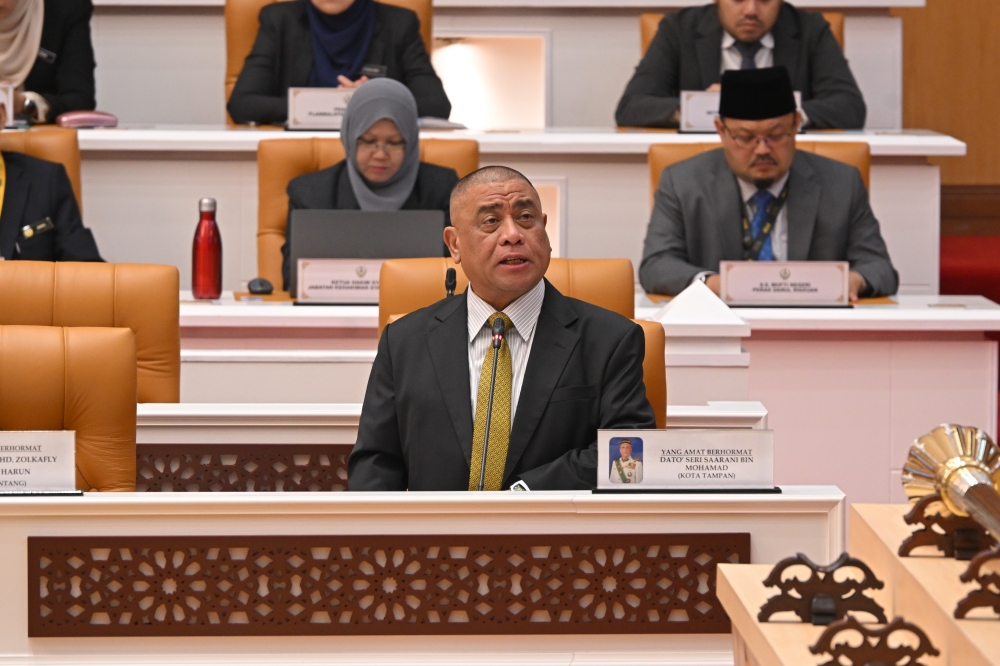
Speaking at the State Legislative Assembly, Perak Menteri Besar Datuk Seri Saarani Mohamad said the state government was taking the phenomenon seriously, as it could bring hotter and drier weather than usual, particularly during the Southwest Monsoon from May 14 to September this year.
He said the phenomenon was expected to persist until early 2027, prompting the state government to continuously strengthen its preparedness measures.
“Through the State Disaster Management Committee (JPBN), technical agencies such as the Malaysian Meteorological Department (MetMalaysia), Department of Irrigation and Drainage (JPS) and Perak Water Board (LAP) are continuously monitoring and reporting weather forecasts and water levels at major dams.
“This includes Bukit Merah Dam and Sultan Azlan Shah Dam,” he said.
Saarani was responding to an oral question from Bota assemblyman Najihatussalehah Ahmad about the state government’s plans and preparedness for the Super El Niño phenomenon.
On public health, Saarani said the Perak Health Department (JKN Perak) was guided by the Health Ministry’s 2021 Action Plan for Managing Health Risks from Heatwaves.
He said four main strategies had been outlined, namely targeted health advocacy, daily surveillance of heat-related illnesses, haze and waterborne diseases, activation of the crisis preparedness and response centre if a heatwave warning was issued, and ensuring the continuity of health facility operations.
“JKN Perak, together with LAP, gives the highest priority to water supplies for hospitals and clinics, with a minimum 48-hour storage tank reserve.
“This also includes ensuring sufficient supplies of critical medicines,” he said.
In the agricultural sector, Saarani said the state government was focusing on the efficient management and distribution of water resources through major irrigation infrastructure and the mobilisation of mobile pumps for water recycling.
He said structured agricultural areas such as IADA Seberang Perak were being closely monitored due to their reliance on gravity-flow irrigation systems, which could be affected by declining water levels.
“Should the situation become increasingly critical, JPBN, together with NADMA and MetMalaysia, is prepared to coordinate cloud-seeding operations in targeted catchment areas,” he said.
On environmental measures, Saarani said DOE had activated the National Open Burning Action Plan and the Peatland Fire Operations Action Plan.
He said the department was conducting daily patrols at hotspot locations, including during the day, at night and on public holidays.
“The DOE is also using drones for monitoring and enforcing penalties under Section 29A of the Environmental Quality Act (Amendment) 2024, which provides for compounds of up to RM500,000 and fines of up to RM1 million,” he said.
Saarani said DOE was also working with local authorities, the police and the Fire and Rescue Department to prevent open burning that could worsen air quality and pollution levels.
He said DOE was also regularly monitoring Air Pollutant Index (API) readings at high-risk locations to allow early warnings to be issued promptly.
He said LAP had activated a phased mitigation plan covering the optimisation of water treatment plant operations, water supply rezoning, mobilisation of water tankers, deployment of static water tanks and the use of alternative water sources.
LAP had also applied for RM2.4 million from the Ministry of Agriculture and Food Security for mitigation measures in affected areas.
“LAP is also working closely with the National Water Services Commission through a war room mechanism to proactively manage any risk of a water crisis,” he added.
Meanwhile, Saarani said the Department of Agriculture, together with the Department of Minerals and Geoscience, had updated and activated more than 100 tube wells at strategic locations to provide groundwater for crops and livestock.
He said farmers were also receiving smart agriculture training as a long-term measure to improve water-use efficiency and ensure continued production.
“This includes technical applications involving the Internet of Things (IoT) and modern farm management systems at district agricultural development training centres,” he said.
He said the state government would activate the State Disaster Operations Control Centre under JPBN if necessary to coordinate logistics and emergency water supplies.
“Daily monitoring of early warnings will also continue alongside public awareness campaigns to minimise health risks and enable immediate intervention,” he said.
Date: 9 September, 2026 12:02 pm
Source: Malay Mail
💬 Join the Conversation! 💬
We’ve disabled comments on our posts and pages to keep the discussions organized and lively! But don’t worry – the conversation isn’t over. Head over to our forum and share your thoughts, ideas, and feedback with the community! It’s the perfect place to connect, learn, and engage with others who care about the same things. We can’t wait to hear from you!