
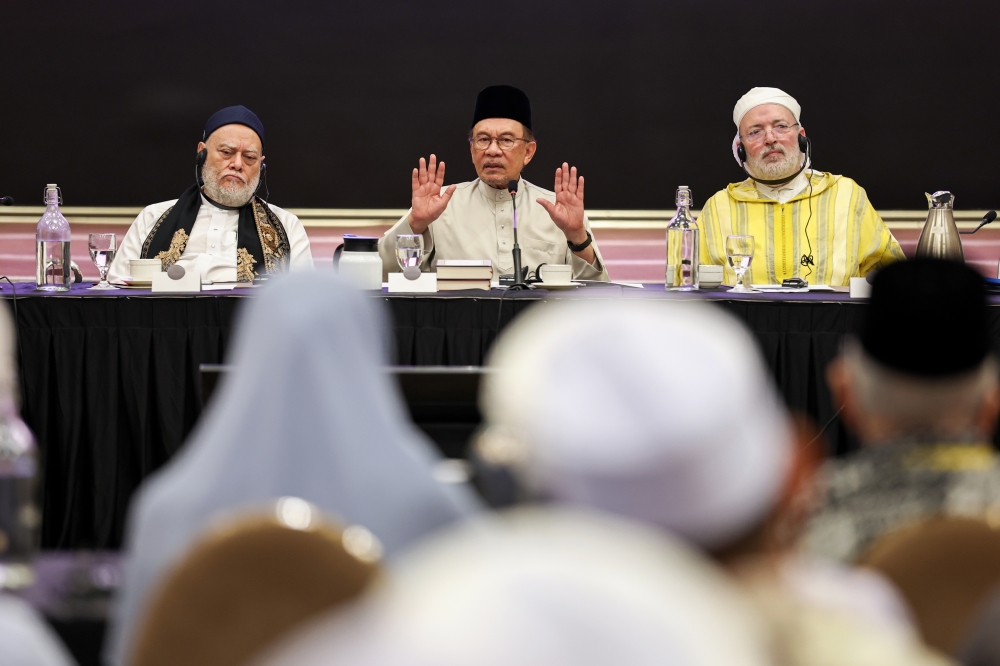
PUTRAJAYA, Sept 19 — The government will help streamline and elevate pondok institutions (traditional religious schools), including in terms of physical facilities, academic disciplines and the introduction of new fields of study suited to current needs, said Datuk Seri Anwar Ibrahim.
The Prime Minister said that, as an initial step, several pondok institutions would be selected to pioneer new traditions of learning based on their respective areas of specialisation and tarbiah or disciplines.
“Since independence in 1957, governments have changed, but this is the first time we are truly assisting.
“I want to emphasise this because many people have raised questions. I will not decide what the (pondok) curriculum is, as it is not my field. I am just proposing how to improve its dignity and position, including through new areas of knowledge and disciplines,” he said in his speech at the opening ceremony of the National Turath Scholars’ Consultation, held in conjunction with the Malaysia Islamic Turath Festival 2026, here today.
Also present were Minister in the Prime Minister’s Department (Religious Affairs) Dr Zulkifli Hasan, Selangor Menteri Besar Datuk Seri Amirudin Shari, former Grand Mufti of Egypt Sheikh Prof Dr Ali Jum’ah Muhammad Abdul Wahab and prominent Moroccan scholar Sheikh Prof Dr Sayyid Idris al-Fasi al-Fihri.
Anwar said pondok institutions also need to be exposed to new disciplines, including artificial intelligence (AI), which he said has great potential as a tool for Islamic outreach and the development of the Muslim community.
“AI is an important tool for Islamic outreach and the revival of Islam, and AI without a system of ethics and morality can become a problem and a major threat that could ultimately harm us.
“There are dangers associated with AI, just as there are with phones and computers. So children in pondok institutions must also be trained to master AI,” he said.
The Prime Minister said efforts to strengthen pondok institutions should also take into account the diverse educational pathways available to their students, adding that not all such institutions necessarily need to produce religious scholars.
“If we say that all pondok institutions must produce religious scholars, that is not possible. Some are specialised (in the religious field).
“Some of them want to go into engineering, want to become pilots, want to venture into TVET (Technical and Vocational Education and Training), I think that is not a problem. At least they have sufficient knowledge and a religious foundation,” he added.
At the same time, Anwar said some pondok institutions need to have pathways to universities to enable their graduates to contribute to the public education system.
“I agree that even if we recognise pondok programmes up to the higher-education level, it does not necessarily mean their graduates must go to university. That is fine. I agree. There is no problem with that.
“But we must remember that for some pondok institutions, having a pathway to university is also important as their graduates will go on to influence the public education system,” he added. — Bernama
Date: 19 September, 2026 2:23 pm
Source: Malay Mail
💬 Join the Conversation! 💬
We’ve disabled comments on our posts and pages to keep the discussions organized and lively! But don’t worry – the conversation isn’t over. Head over to our forum and share your thoughts, ideas, and feedback with the community! It’s the perfect place to connect, learn, and engage with others who care about the same things. We can’t wait to hear from you!