
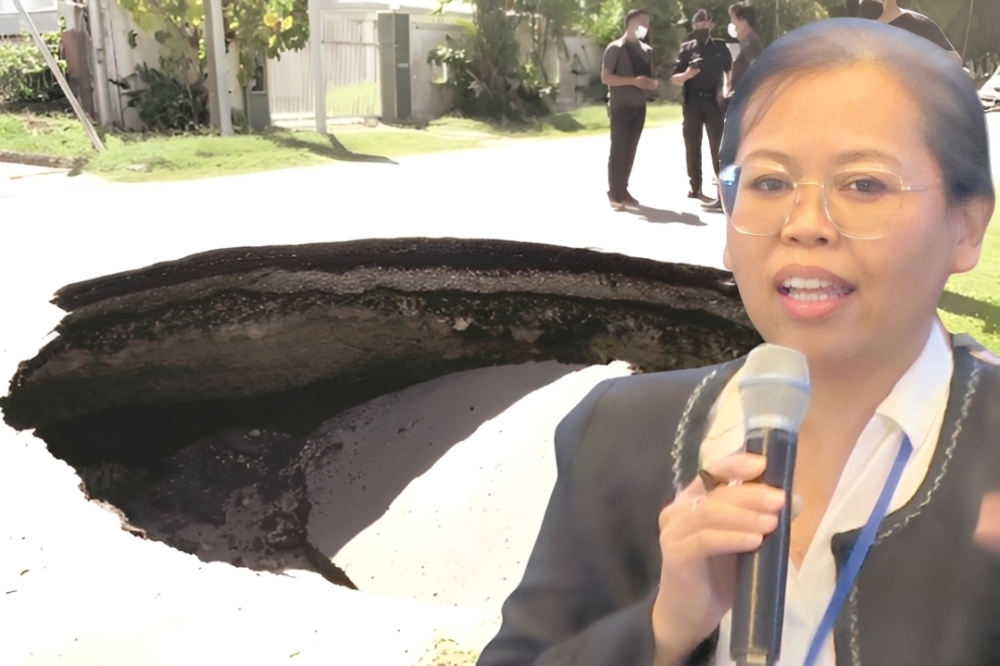
KOTA KINABALU, April 27 — Sabah’s sewerage pipes – many going back 20 to 30 years – are crumbling and causing sinkholes (pic), burst pipes and leaks, with most parts of the State still depending on septic tanks instead of proper treatment systems.
“The pipes were constructed years ago and we are now seeing a lot of complaints coming in from localised hotspots, leakages and bursting pipes,” said State Sewerage Service Department Chief Assistant Director Jenni Alliviana Suallih.
“The worst part is the sinkholes that are happening,” she said, adding that the Department is working out how to carry out repairs without disturbing surrounding facilities and the environment.
Jenni was among panellists at the two-day Plumbing Asia 2026 Conference and Expo held at the Sabah International Convention Centre, over the weekend.
The conference, themed Smart Water, Strong Nation, Sustainable Asian Future, was organised by the Sabah Plumber Association and Koperasi Persatuan Tukang Paip Sabah Berhad in collaboration with the Sabah Water Department and the Kadazandusun Chamber of Commerce and Industry. Daily Express is media partner for the event.
Jenni said physical development was outpacing the sewerage systems meant to support it.
“The development is there, but the infrastructure is still in the background. We need to re-look and re-study how the progress of development itself is going and how our infrastructure is keeping up, especially since our systems have not been reviewed in the past 20 to 30 years,” she said.
With sewerage coverage still thin across the State, most of Sabah continue to depend on individual septic tanks.
“What the Department can do is have a master plan to make it centralised, decentralised or regionalised. Towards the end, what we are most concerned about is the environment,” she said.
The Department is working closely with the Environment Department, the Water Department and other agencies managing water bodies.
“We have a lot of challenges getting the information and getting the inventory, operations and maintenance manuals in order,” she said, pointing out the difficulty being a shortage of proper records.
“The Department was only recently set up to manage sewage in Sabah, so aligning everything, including the assets themselves, has been a real challenge for us on the government side,” she added.
On long-term planning, she said, “It is not about building more assets or planting more sewage treatment plants just to produce a better outlet of treated water.”
“What we need is to look at what the right expansion spending is like over the next five to 10 years,” Jenni said, adding that protecting water intake points and water bodies is central to that thinking.
“We need strategic collaborations with other industry players, institutions and non-governmental organisations to update ourselves and gain whatever latest technology we can adopt into our systems.”
A sewerage master plan is already in place to extend coverage across every district in Sabah.
“We are prioritising the urban and industrial areas first and we are also looking at tourism hubs like Semporna, etc. The water villages there are quite a challenge because each one is running on its own individual system, so we are trying to collect as much data as we can,” she said.
The Department is also stepping into sludge waste management, with ongoing projects being monitored for results.
“We are looking at technology transfers from other countries, including China and New Zealand and that is part of the planning for our infrastructure in Sabah.
“Additionally, we are working to enforce the enactment in terms of licensing and to make sure that the compliance standards we have already set are being met. The enforcement needs to be in place as well,” she said, pointing out the Sabah Sewerage Enactment 2017 as a regulatory backbone for the sector.
On technology and industry collaboration, Jenni said, “The government is open to the whole idea of a smarter system, one that is more resilient, easy to handle and cost effective to maintain the assets. We are keen to work together.”
She said monitoring systems and trenchless technologies are particularly useful, the latter allowing underground repair works to be carried out with minimal disruption to roads and surrounding areas, while noting that more exploration was still needed to get the best out of these tools.
On what the single most urgent action for Sabah should be right now, Jenni said, “From our point of view, it is public awareness. We have a lot of littering, rubbish and grease being disposed of the wrong way, and that is going straight into the system.” — Daily Express
Date: 27 April, 2026 1:00 pm
Source: Malay Mail
💬 Join the Conversation! 💬
We’ve disabled comments on our posts and pages to keep the discussions organized and lively! But don’t worry – the conversation isn’t over. Head over to our forum and share your thoughts, ideas, and feedback with the community! It’s the perfect place to connect, learn, and engage with others who care about the same things. We can’t wait to hear from you!