
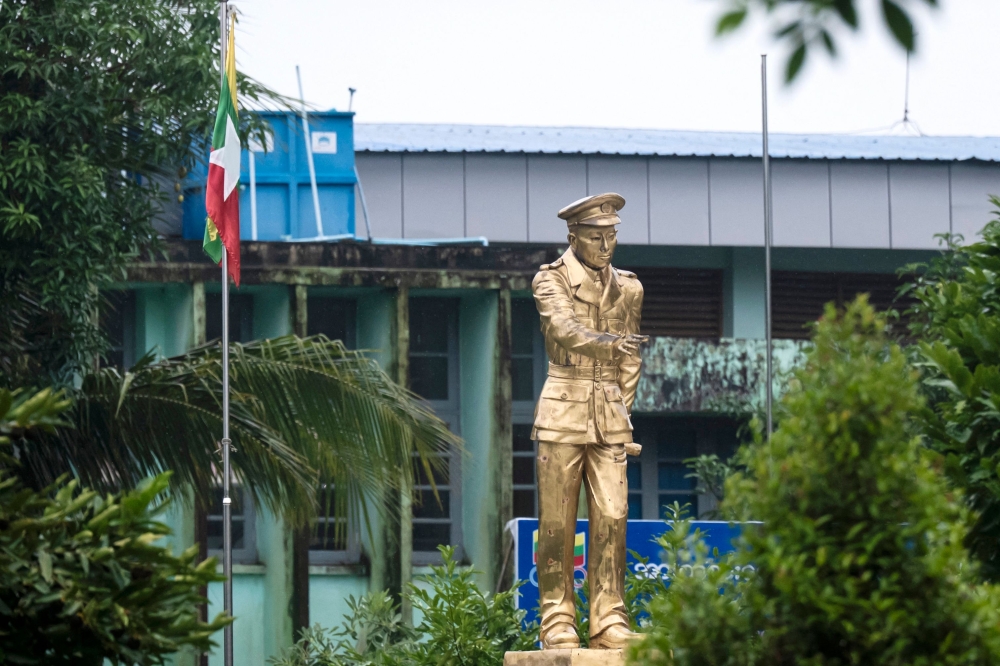
YANGON, July 18 — Statues of independence hero Aung San are quietly disappearing across Myanmar in a contest over his legacy as father of both the nation and of detained democracy figurehead Aung San Suu Kyi.
General Aung San fought with and against both the British and the Japanese colonisers as he sought independence, but was assassinated on July 19, 1947, just months before his dream was realised.
Considered the father of modern-day Myanmar, his statues have dotted the country for decades.
Many were added while Suu Kyi’s party was in power – and many are now being taken down by the government of Min Aung Hlaing, the coup leader who ousted her in 2021.
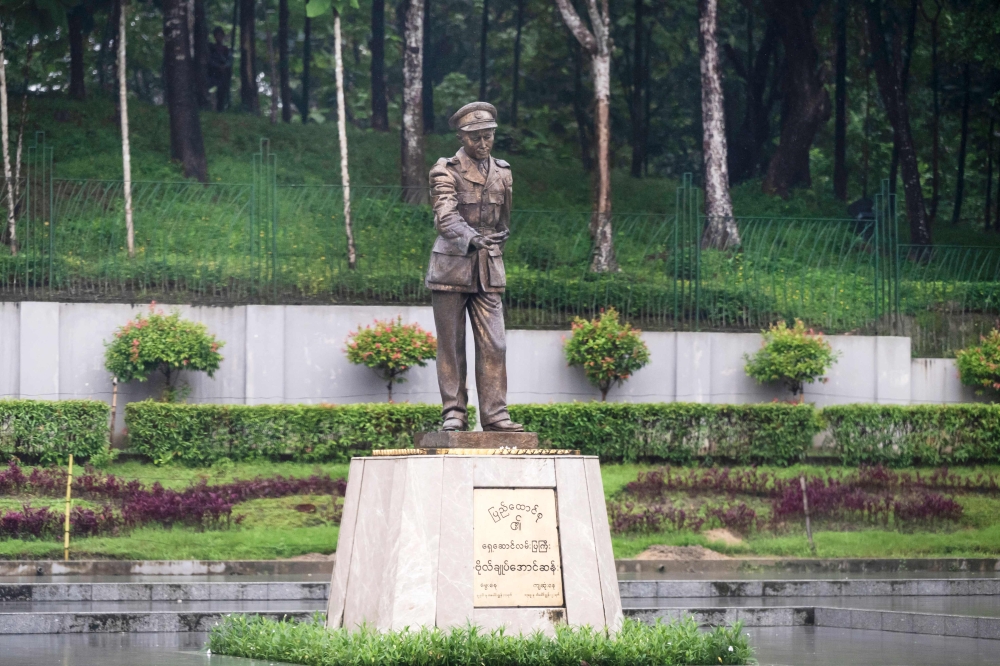
In Yangon’s Thu Mingalar Park, an AFP reporter this week noted the absence of one towering likeness installed almost a decade ago, grass newly planted in its place.
The government has acknowledged taking down some statues it said had “incorrect proportions and shapes”.
But analysts say the removals may be an attempt to erase from public spaces a powerful symbol linked to Suu Kyi, the popular Nobel laureate who remains detained.
Aung San is “engraved in people’s memory” as Myanmar’s independence hero, and many see his legacy being continued by his daughter, according to Myanmar specialist Moe Thuzar.
Historical legacy
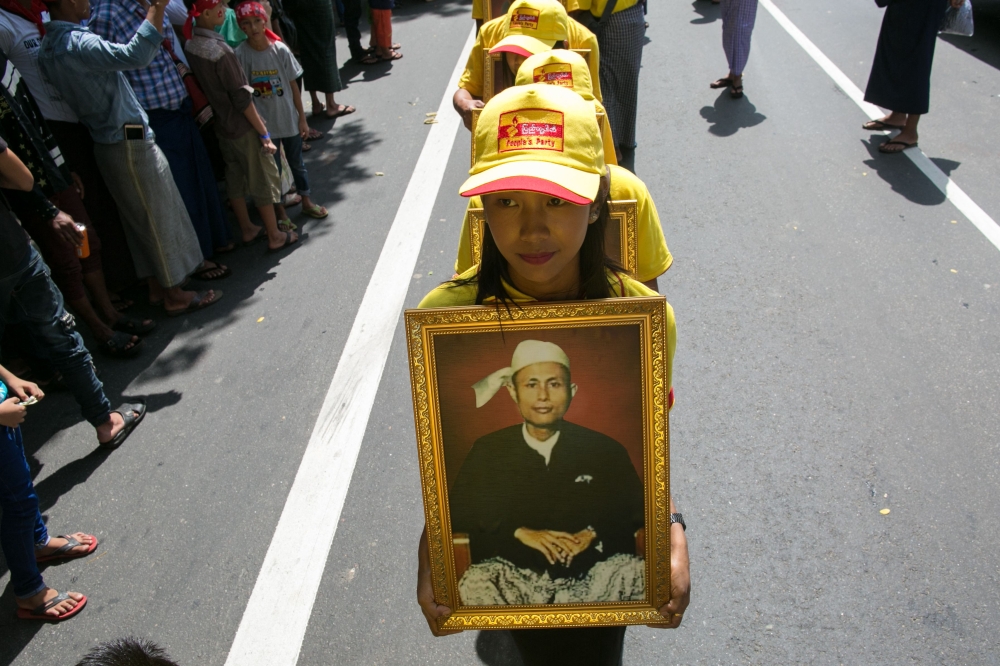
While in power from 2016-2020, during Myanmar’s decade-long experiment with democracy, Suu Kyi’s National League for Democracy (NLD) put up statues and also returned Aung San’s face to local currency notes.
They could be seen as “efforts to revive his historical legacy”, Moe Thuzar said.
Since the coup, which triggered a devastating civil war, the military has focused on making Suu Kyi and the NLD “politically irrelevant”, she added.
But erasing the memory of Suu Kyi’s father is unlikely.
The murder of Aung San and several of his colleagues by local rivals is marked each year as Martyrs’ Day, a public holiday when thousands pay their respects at the Yangon mausoleum that holds the victims’ remains.
“They can remove the statues, but they can never erase Bogyoke’s image,” one Yangon resident said, using the Burmese word for general to describe Aung San.
“They already hold power, and they have the weapons and the military. I don’t know what they are still so afraid of,” the 34-year-old said, speaking anonymously due to security concerns.
‘Incorrect proportions’
After local media reported the removal of several statues, government spokeswoman Khaing Khaing Soe said earlier this month that only those with “incorrect proportions and shapes are being systematically reviewed and addressed”.
Since 2016, she said in a statement, a review of Aung San statues in more than 100 townships had found some had features “inconsistent with the dignity of such an important historical figure”.
“Systematic maintenance efforts are being carried out” to prevent “any disrespect toward the commemorative statues”, and to ensure “future generations can continue to study Myanmar’s historical heritage in a correct and appropriate manner”, she added.
One statue installed during the NLD administration was removed earlier this month from Mya Kan Thar Park in Yangon, a local resident said.
Another resident in the township said the statue had been “totally fine, with good proportions”.
In late June, authorities also removed a statue from a park in Mudon, in southern Mon state, said a resident speaking anonymously.
Authorities later covered the foundation of the 2019 statue with a plastic sheet, the resident said, adding: “No one has dared to complain.”
Not everyone’s hero
Despite his national hero status, Aung San is feted mostly by ethnic majority Bamar elites, rather than the ethnic minority groups who have fought against central rule for decades, researcher Morgan Michaels said.
Under the Suu Kyi-led government, there were several arguments with ethnic minority groups over the NLD’s attempts to erect statues or name infrastructure after Aung San, said Michaels, a Myanmar specialist with the International Institute for Strategic Studies.
The Kachin and the Karenni, for example, “have their own heroes”.
“They don’t appreciate the imposition… of his likeness and the symbolism that is attached to him, because it’s also a symbol of the Bamar dominance of the state,” he said.
Since the coup, some of Myanmar’s myriad ethnic minority factions have banded with pro-democracy guerrillas to fight the armed forces.
A politician from one ethnic minority group, who declined to be named, acknowledged Aung San’s struggle for independence but accused the NLD of erecting statues “for their party’s interest”.
“It’s not necessary to keep many of his statues,” the politician said, adding of the NLD: “Their era is finished now.” — AFP
Date: 18 July, 2026 3:00 pm
Source: Malay Mail
💬 Join the Conversation! 💬
We’ve disabled comments on our posts and pages to keep the discussions organized and lively! But don’t worry – the conversation isn’t over. Head over to our forum and share your thoughts, ideas, and feedback with the community! It’s the perfect place to connect, learn, and engage with others who care about the same things. We can’t wait to hear from you!