
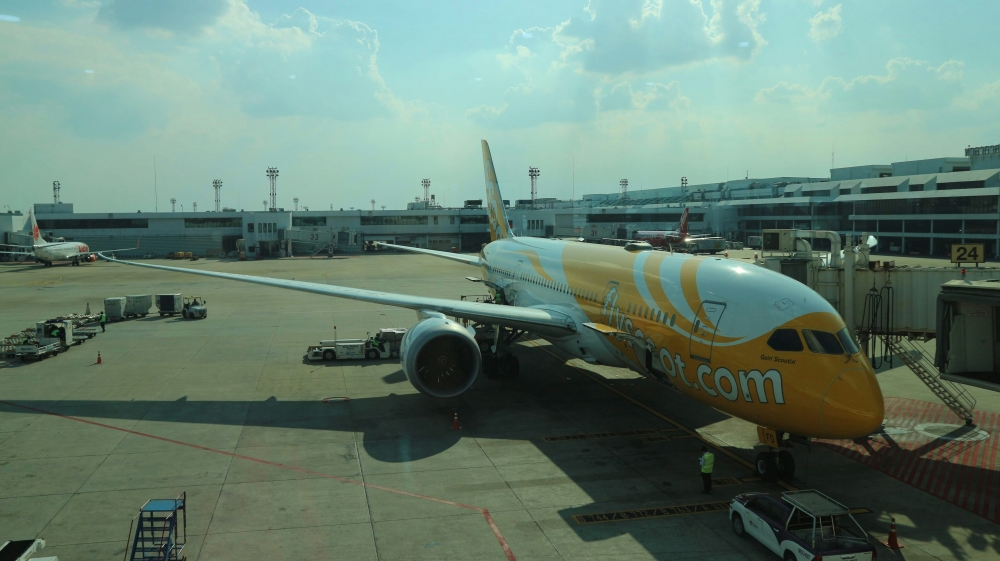
KUALA LUMPUR, July 26 — Malaysia remains a key market for Scoot, the low-cost carrier of the Singapore Airlines (SIA) Group, driven by sustained demand for leisure and business travel, the airline’s chief commercial officer Calvin Chan said.
He said Scoot now serves 12 destinations in Malaysia, mounting 130 weekly flights between both countries.
Chan said the airline has also widened its regional footprint in Southeast Asia, flying to at least half a dozen new destinations and increasing frequencies to places it is already flying to.
As at the end of June 2026, Scoot operated a network of 85 destinations across 18 countries and territories, he told Bernama in a recent interview.
The airline currently operates more than 60 aircraft, comprising 24 Boeing 787 Dreamliners, 30 Airbus A320 family aircraft and nine Embraer E190-E2 jets.
For the financial year ended March 31, 2026, Scoot flew more than 2.2 million passengers to and from its Malaysian destinations, representing approximately a 14 per cent year-on-year increase.
He said that brisk tourist arrivals from the Visit Malaysia 2026 campaign also help make Malaysia a vibrant destination, despite intense competition in the low-cost carrier segment.
These factors have combined to generate strong demand for air travel between Malaysia and Singapore, he said.
Malaysia continues to play a strategic role in the airline’s network, supported by Putrajaya’s close economic and social ties with Singapore.
He said Malaysia serves as an important source of both point-to-point traffic and connecting passengers into the wider SIA Group network via Singapore.
Tourist arrivals remain particularly robust, with Malaysia continuing to be a top travel destination for Singaporean travellers.
“In the first two months of 2026, 3.4 million Singaporean visitors travelled to Malaysia, accounting for nearly half of total international tourist arrivals,” he said.
To date, the 12 destinations Scoot serves in Malaysia include Ipoh, Kota Bahru, Kota Kinabalu, Kuala Lumpur, Kuantan, Kuching, Langkawi, Melaka, Miri, Penang, Sibu and Subang.
This makes Scoot the only foreign airline serving the highest number of destinations in Malaysia.
Chan said the Kuala Lumpur-Singapore route continues to be one of the world’s busiest international air corridors, with demand remaining resilient across both leisure and business travel segments.
He said Malaysia’s tourism prospects are expected to receive a further boost from the Visit Malaysia 2026 campaign, with Scoot well positioned to support the country’s tourism ambitions through its extensive regional network.
To capitalise on the expected growth, Scoot entered a three-year strategic partnership with Tourism Malaysia in August 2025 to jointly promote the country across key markets, including Singapore, China, Australia and Indonesia.
He said the collaboration, which runs until 2028, aims to drive international visitor arrivals through joint marketing initiatives with tourism stakeholders.
Chan added that Scoot currently operates seven weekly flights to Subang using Airbus A320 family aircraft and will continue evaluating opportunities to expand its presence in Malaysia based on travel demand, operational considerations and its broader network strategy.
Southeast Asia remains growth engine
Beyond Malaysia, Chan said Southeast Asia will continue to be Scoot’s primary growth engine over the next few years, underpinned by rising disposable incomes, expanding airport infrastructure and travellers’ growing preference for affordable short-haul travel.
He said the airline has steadily expanded its regional footprint over the past year.
During that period, Scoot launched services to Chiang Rai and Palembang in January, followed by Medan and Tokyo Haneda in February and March, before adding Belitung and Pontianak in Indonesia during May and June.
Scoot also increased flight frequencies to several destinations across the region, including Bali, Jakarta, Labuan Bajo, Lombok, Manado, Phuket and Sibu, while boosting services to Changsha, Okinawa and Vienna in response to growing demand.
Chan said the airline will continue pursuing disciplined, demand-led expansion across short, medium and long-haul markets while maintaining a commercially sustainable and diversified network.
Fleet and digital investments
Touching on its fleet, Chan said the Embraer E190-E2 aircraft enables Scoot to serve secondary cities and airports with infrastructure constraints while complementing its larger Airbus A320 family and Boeing 787 fleets.
In May this year, Scoot announced a firm order for five Airbus A320neo family aircraft and exercised options for an additional six, bringing its total A320neo family orderbook to 20 aircraft.
The additional aircraft, scheduled for progressive delivery from 2028, would provide greater flexibility to deploy capacity across regional markets, launch new routes and strengthen connectivity into the wider SIA Group network, said Chan.
While Scoot’s Boeing 787 Dreamliners remain central to its medium- and long-haul operations covering destinations in Australia, North Asia, North India, the Middle East and Europe, Chan said there are no immediate plans to expand the airline’s widebody fleet.
Beyond network and fleet expansion, Scoot will continue investing in digitalisation and artificial intelligence (AI) to enhance operational efficiency and improve customer experience.
Among the initiatives are enhancements to its AI-powered virtual assistant Marvie, expanded self-service capabilities at airports, AI-supported customer service functions and technology-driven operational systems designed to improve productivity, strengthen disruption management and deliver a more seamless travel experience. — Bernama
Date: 26 July, 2026 12:00 pm
Source: Malay Mail
💬 Join the Conversation! 💬
We’ve disabled comments on our posts and pages to keep the discussions organized and lively! But don’t worry – the conversation isn’t over. Head over to our forum and share your thoughts, ideas, and feedback with the community! It’s the perfect place to connect, learn, and engage with others who care about the same things. We can’t wait to hear from you!