
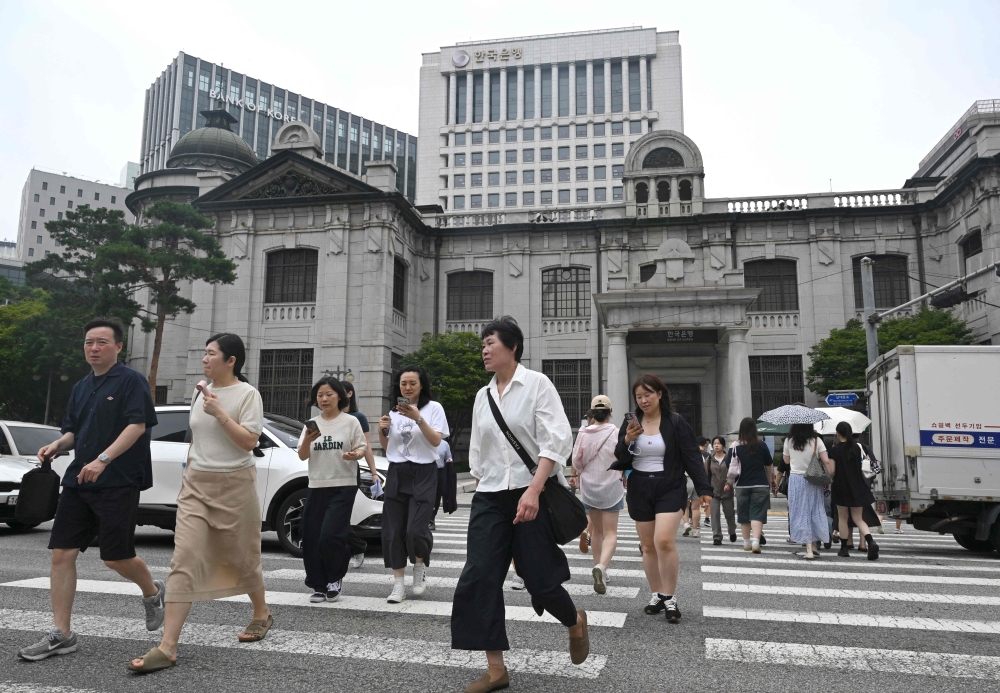
SEOUL, July 16 — South Korea’s central bank hiked interest rates Thursday for the first time in more than three years and indicated more to come amid robust economic growth fuelled by the AI chip boom, persistent inflation and risks to financial stability.
The Bank of Korea has increasingly leaned toward tighter monetary policy owing to stubbornly high inflation, a weaker won and an economy buoyed by strong semiconductor exports.
The combination of robust growth, rising home prices, and elevated household debt has strengthened the case.
On Thursday an official at the bank told AFP the Monetary Policy Board had “raised the benchmark rate from 2.5 per cent to 2.75 per cent”.
The increase was the first since January 2023, when it lifted the policy rate 25 basis points to 3.5 per cent during its post-pandemic policy normalisation cycle.
The bank deemed it was “appropriate” to raise the rate “as economic growth has been strengthening”, and “inflation is expected to remain above the target level for a considerable period”, the bank said in a statement.
It added that “risks to financial stability continue to persist”.
South Korea’s economy expanded at its fastest pace for nearly six years in the first quarter as exports surged on the back of demand for chips that power artificial intelligence.
The government this week raised its 2026 growth forecast by one percentage point to three per cent owing to the strong performance of memory chipmakers as artificial intelligence demand soars.
Record profits from semiconductor giants Samsung Electronics and SK hynix — whose advanced memory chips are essential for the fast-evolving AI sector — have fuelled optimism over the country’s economic outlook.
Consumer prices climbed 3.2 per cent in June from a year earlier, partly because of higher energy costs and supply chain disruptions linked to the Iran war.
The BoK reiterated Thursday that it “remains necessary to closely monitor high exchange rate volatility, the upward trend in housing prices in the Seoul metropolitan area, and the accelerating growth of household debt”.
“Accordingly, the Board considers it necessary to maintain its policy of raising interest rates,” it added.
“The timing and pace of any further rate increases will be determined after assessing inflationary pressures… and financial stability conditions.”
Dave Chia, an economist at Moody’s Analytics, said the increase marked “the start of a tightening cycle rather than a one-off adjustment”.
“Oil is putting the most pressure on prices. The Middle East conflict has kept crude costly for an economy almost wholly reliant on imported energy,” he said in a note sent to AFP.
“Underlying pressure is therefore stronger than the headline. A weak won amplifies the pressure through import prices.” — AFP
Date: 16 July, 2026 4:05 pm
Source: Malay Mail
💬 Join the Conversation! 💬
We’ve disabled comments on our posts and pages to keep the discussions organized and lively! But don’t worry – the conversation isn’t over. Head over to our forum and share your thoughts, ideas, and feedback with the community! It’s the perfect place to connect, learn, and engage with others who care about the same things. We can’t wait to hear from you!