
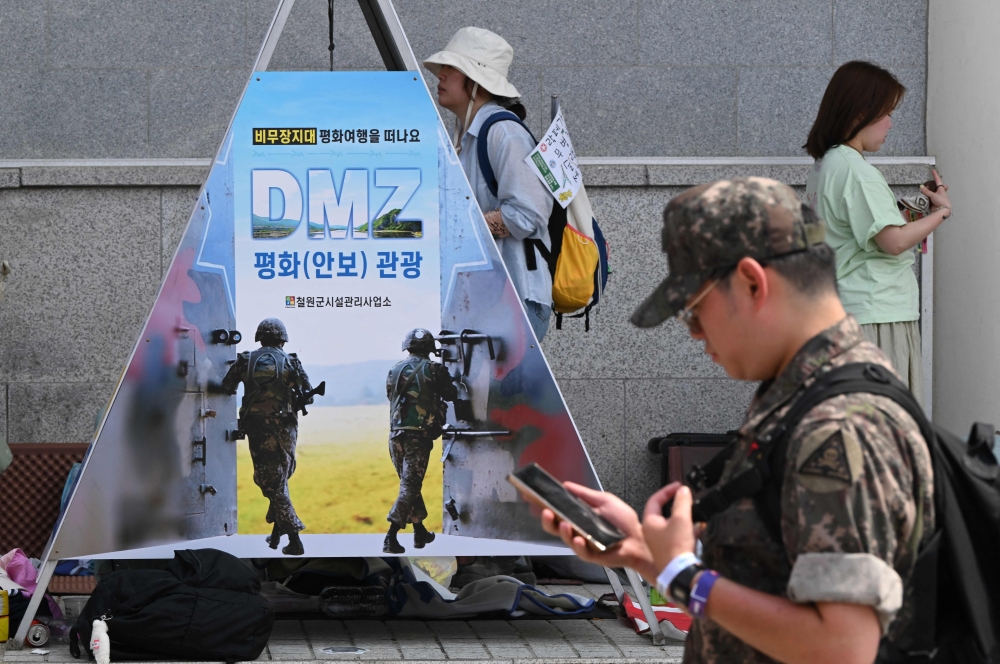
SEOUL, June 17 — Civilians in South Korea will be able to get several kilometres nearer North Korea under new rules broadening public access to the highly militarised border zone, Seoul’s defence ministry said on Wednesday.
The two Koreas remain technically at war because their 1950-53 conflict ended in an armistice, not a peace treaty, and are separated by a demilitarised zone through which the border runs.
A Civilian Control Line (CCL) has long restricted civilian access to areas within 10 kilometres (6.2 miles) south of the heavily fortified border in order to protect military facilities.
The CCL will be shrunk to an average of six kilometres starting 2027, Defence Minister Ahn Gyu-back told reporters in Seoul, increasing access for villagers and farmers, and visitors to the region.
Ordinary South Korean citizens require permission from the military to reside or farm in the area, and analysts say residents have long faced significant economic disadvantages.
The new measures aim to “enhance the convenience of local residents while ensuring the effectiveness of military operations”, said Ahn.
They would include a significant simplification of flight approval procedures for agricultural drones.
“We will enable regional development to the extent that it does not interfere with military operations, Ahn said.
Residents welcomed the move, saying it would allow freer farming activities in the area and boost development and tourism.
Kim Deok-hyeon, mayor of Yeoncheon county near the inter-Korean border, said the measures would “significantly alleviate the inconvenience faced by local farmers.”
Councillor Park Heung-yeol of Ganghwa County told AFP that construction even on privately-owned land within the controlled area requires military approval.
This area will now be smaller.
“Local residents have long harboured complaints due to inconveniences regarding access procedures and the inability to exercise their property rights,” added Kim Seok-in, another county official.
The new measure would bring “significant advantages for regional development,” he added.
CCTV
Analysts said the measure was unlikely to upset North Korea, as it concerns areas on the South’s side of the border.
South Korea removed loudspeakers last year that were used to blast K-pop and news broadcasts into the North, as the dovish government of Lee Jae Myung sought to ease tensions with its diplomatically isolated, nuclear-armed neighbour.
Under his hawkish predecessor Yoon Suk Yeol, Pyongyang transmitted bizarre and unsettling noises across the border that became a major nuisance for residents in nearby South Korean regions.
Analysts said the move also had to do with smaller troop numbers.
“South Korea is increasingly relying on technologies such as CCTV and mobile apps to secure front-line areas,” Lim Eul-chul, a North Korea expert at Kyungnam University, told AFP.
It reflects “a view that the AI era has made traditional manpower-intensive border patrols obsolete”. — AFP
Date: 17 June, 2026 5:00 pm
Source: Malay Mail
💬 Join the Conversation! 💬
We’ve disabled comments on our posts and pages to keep the discussions organized and lively! But don’t worry – the conversation isn’t over. Head over to our forum and share your thoughts, ideas, and feedback with the community! It’s the perfect place to connect, learn, and engage with others who care about the same things. We can’t wait to hear from you!