
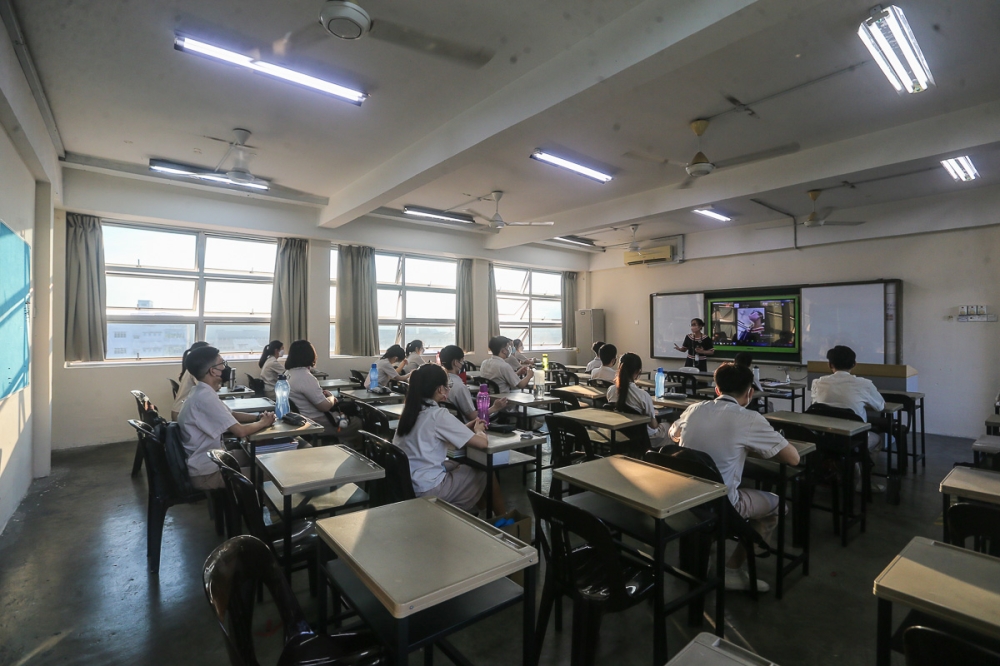
KUALA LUMPUR, May 21 — From national schools and vernacular streams to tahfiz institutions, Chinese independent schools, international campuses and alternative learning systems, Malaysia’s education landscape reflects the country’s multicultural roots and evolving social priorities.
While the system may appear complex, many of these institutions continue to coexist because they serve different linguistic, religious, cultural and academic needs among Malaysian families.
Some were established before independence while others emerged alongside modernisation and globalisation, but many remain active today and continue producing students who move into universities, professional careers and public service.
Although pathways differ depending on the qualifications obtained, much of Malaysia’s education ecosystem remains interconnected through examinations such as the Sijil Pelajaran Malaysia (SPM) and internationally recognised certifications.
The national school system
Malaysia’s largest education stream remains the government school system under the Ministry of Education, comprising Sekolah Kebangsaan (SK) and Sekolah Menengah Kebangsaan (SMK).
These schools are fully government-funded and recognised for public universities, civil service employment, government scholarships and public-sector careers.
They primarily use Bahasa Malaysia, follow the national syllabus and prepare students for examinations such as the SPM and Sijil Tinggi Persekolahan Malaysia (STPM), alongside matriculation programmes.
The system also includes specialised streams such as Sekolah Berasrama Penuh (SBP), Maktab Rendah Sains MARA (MRSM), technical and vocational institutions, and Sekolah Menengah Kebangsaan Agama (SMKA).
Who can enrol:
National schools are open to all Malaysians, although entry into elite boarding and science schools is usually based on academic achievement and, in some cases, Bumiputera eligibility requirements.
Vernacular school system
These schools emerged during the colonial era when migrant Chinese and Indian communities established their own institutions to continue education in their mother tongues and maintain cultural traditions.
Sekolah Jenis Kebangsaan Cina (SJKC) primarily teach in Mandarin while Sekolah Jenis Kebangsaan Tamil (SJKT) use Tamil as the main medium of instruction.
After independence, the schools continued operating within Malaysia’s broader education framework and were later incorporated into the national system as government-aided schools.
Although the teaching language differs, both streams still follow the national curriculum and remain officially recognised under the national education system, with students eventually sitting for examinations such as the SPM and STPM.
Who can enrol:
These schools are open to all Malaysians regardless of ethnicity.
Pondok and tahfiz education
Before modern state schooling expanded, many Malay-Muslim communities relied on religious institutions for education, leading to the existence of pondok schools focused on Quranic studies, theology and classical Islamic texts.
Historically, pondok schools operated outside the national academic framework, although modernised versions increasingly integrate national syllabus subjects and examinations such as the SPM and Sijil Tinggi Agama Malaysia (STAM).
Tahfiz schools later emerged with a stronger focus on Quran memorisation, or hafazan.
Today, tahfiz education exists in multiple forms, including government-supported tahfiz schools, integrated tahfiz programmes, private tahfiz schools and independent religious schools.
Some integrated and government-supported tahfiz schools combine religious studies with mainstream academic subjects such as science, mathematics and English, including through models such as Ulul Albab, which blend religious and academic education within the national framework.
Who can enrol:
Pondok and tahfiz institutions are generally open to Muslim students.
Chinese independent schools and the UEC
Chinese independent high schools form another major parallel education stream in Malaysia.
These schools use Mandarin as the primary teaching language and operate outside the national curriculum.
Students usually sit for the Unified Examination Certificate (UEC), coordinated by the United Chinese School Committees’ Association of Malaysia (Dong Zong).
The UEC is widely recognised by many overseas universities and private universities in Malaysia.
Historically, the UEC has not been recognised on its own for direct entry into most federal public universities or many civil service positions, although limited or conditional pathways have gradually emerged in recent years.
Today, some conditional pathways have been introduced for certain UEC holders, particularly when accompanied by national examination requirements such as the SPM.
As a result, many students from Chinese independent schools also sit for the SPM separately to maintain access to public-sector and local university pathways.
Who can enrol:
Chinese independent schools are generally open to all students regardless of ethnicity or religion.
Private and international schools
Private schools expanded significantly from the 1980s onward as demand grew for English-medium learning, smaller class sizes and alternative teaching approaches.
Many private schools still follow the national syllabus or hybrid systems combining SPM and International General Certificate of Secondary Education (IGCSE) pathways.
International schools, originally established mainly for expatriates, now also attract growing numbers of Malaysians.
Unlike national schools, international schools follow foreign syllabuses such as Cambridge IGCSE, International Baccalaureate (IB), American, Australian and Canadian systems.
While these qualifications are widely recognised by private and overseas universities, entry into certain public-sector pathways in Malaysia may still require national qualifications or additional requirements.
Who can enrol:
Private and international schools are generally open to all students, subject to tuition affordability, assessments and school-specific entry requirements.
Alternative education systems
Malaysia has also seen growing interest in homeschooling, Montessori, Waldorf and other alternative learning models.
These systems are often chosen by parents seeking more flexible, holistic or less exam-focused education.
Although many do not directly follow the national syllabus, students may still sit for recognised qualifications such as the SPM, IGCSE, A-Levels or IB as private candidates.
Who can enrol:
Alternative education systems are generally pursued by families seeking customised learning environments, including children with different learning needs, students transitioning from mainstream systems or parents preferring less exam-focused education. Homeschooling at the primary level may also require approval or exemption from the Ministry of Education.
Recognition and qualifications
Recognition in Malaysia generally depends less on the school type and more on the qualifications students eventually obtain.
National qualifications such as the SPM, STPM and matriculation remain fully recognised for public universities, civil service employment and government scholarships, while international qualifications such as the IGCSE, IB and A-Levels are widely accepted for private and overseas tertiary education.
Students from tahfiz, pondok and alternative education backgrounds may also enter mainstream higher education and public-sector careers if they later obtain recognised qualifications.
A system shaped by history and society
Malaysia’s education landscape evolved through layers of colonial history, migration, religion, language and globalisation.
As a result, many education streams continue to exist because they serve different social, cultural and academic priorities among Malaysian families.
For some, preserving language and culture remains central, while others prioritise religious education, international mobility, technical skills, stronger English proficiency or alternative teaching philosophies.
Despite periodic debates over national unity and education reform, Malaysia’s multiple education streams continue to operate in parallel, reflecting the country’s historical, linguistic and religious diversity.
Date: 21 May, 2026 8:00 am
Source: Malay Mail
💬 Join the Conversation! 💬
We’ve disabled comments on our posts and pages to keep the discussions organized and lively! But don’t worry – the conversation isn’t over. Head over to our forum and share your thoughts, ideas, and feedback with the community! It’s the perfect place to connect, learn, and engage with others who care about the same things. We can’t wait to hear from you!