
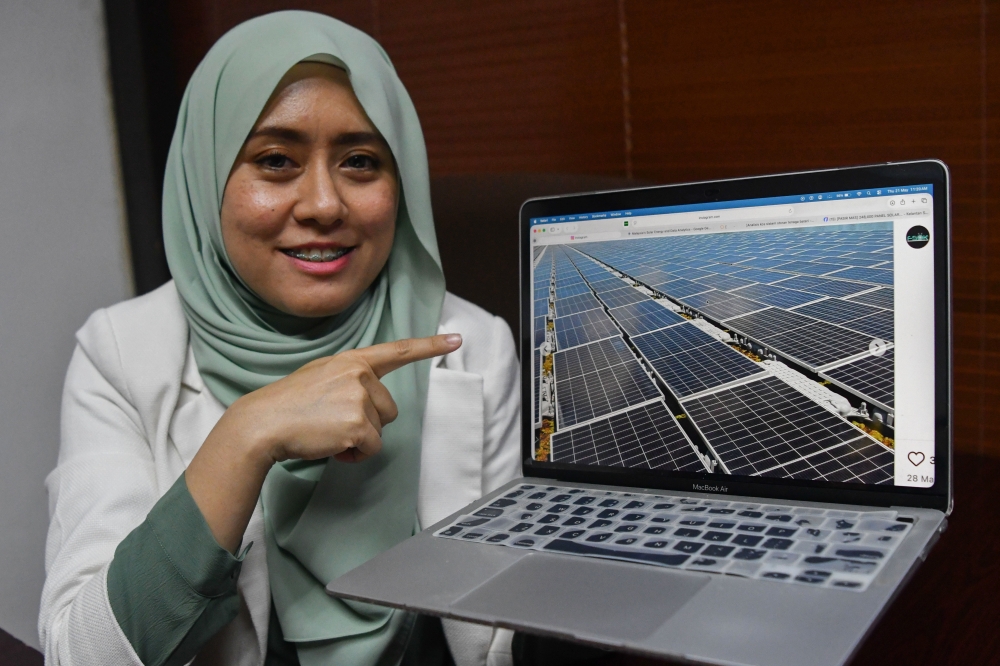
KOTA BHARU, June 2 — Despite its significant geographical and climatic potential to become the nation’s renewable energy (RE) hub or economic hotspot, Kelantan has seen slow adoption of renewable energy technology at the household and small and medium enterprise (SME) levels.
Associate Professor Hasyiya Karimah Adli of the Faculty of Data Science and Computing, Universiti Malaysia Kelantan (UMK), said that although large-scale solar projects have begun to emerge in the state, public awareness and uptake of private solar systems remain low due to the high upfront capital costs.
The academic, who is also a researcher, said the cost of installing a domestic solar panel system is currently estimated at between RM15,000 and RM30,000 for a typical house.
“Kelantan’s relatively flat terrain, coupled with consistent sunlight exposure and high solar radiation levels ranging from 4.21 to 5.56 kWh/m² per day, makes the state highly suitable for the solar industry.
“However, adoption at the household level remains slow. The public may not be aware that the government has introduced various initiatives, such as solar leasing schemes, which do not require any upfront capital,” she told Bernama recently.
Elaborating on Kelantan’s potential, Hasyiya Karimah said the state records annual electricity consumption of between 2,500 GWh and 3,000 GWh, and based on data analytics calculations, it would require only about 2.22 GWp (gigawatt-peak) of installed capacity to meet 100 per cent of its own electricity needs.
“This capacity would technically require approximately 7.777 acres of land. While this may appear substantial, it actually represents only 0.2 per cent of Kelantan’s total land area of 3.7 million acres. We have vast tracts of idle land and sufficient rooftop space,” she said.
She also praised the 98 MWp Danau Tok Uban floating solar plant in Pasir Mas as an exemplary model, noting that the floating solar innovation has successfully addressed the issue of forest clearing while minimising negative impacts on the local environment.
She also highlighted the impact of global developments, including geopolitical tensions in West Asia and the Strait of Hormuz, through which 25 per cent of the world’s oil supply passes, pushing Brent crude oil prices above USD100 per barrel.
“According to a report by Maybank Investment Bank, Malaysia is in a high-risk zone as 69 per cent of the country’s crude oil imports depend on the Persian Gulf region,” she said.
“The fragility of global fossil fuel supplies serves as a warning bell on why Kelantan needs to accelerate its own energy sovereignty. One of the fastest short-term measures is to expand hybrid work-from-home (WFH) policies for civil servants and government-linked companies (GLCs).
To further boost the adoption of green energy, she proposed that the relevant authorities establish a fast-track approval process for domestic solar installation applications.
“Registration procedures need to be streamlined. For example, applications for domestic solar installations with a capacity of less than 10 kilowatt-peak (kWp) should be approved within 48 hours through a green lane mechanism.
“In addition, incentives such as cash rebates or discounts through e-wallet applications, such as the BUDI MADANI platform, could encourage greater consumer participation,” she said.
On the socioeconomic impact, she expressed optimism that the transition to renewable energy, in line with the National Energy Transition Roadmap (NETR), would create thousands of high-skilled jobs for local communities while making the labour market more competitive and digitally savvy.
She added that the demand for skilled workers is rising across various fields, including smart grid management, solar engineering and energy data analytics.
“Educational institutions are also playing an active role. At UMK, we have the Faculty of Data Science and Computing, which utilises artificial intelligence (AI) and machine learning technologies to forecast solar energy generation.
“UMK also offers a Bachelor of Energy Technology programme under the Faculty of Bioengineering and Technology, as well as an Environmental Analytics programme under the Faculty of Earth Sciences,” she said.
She said the growing adoption of electric vehicles (EVs) is currently a key catalyst in the energy transition. Through Vehicle-to-Home (V2H) technology, EV batteries parked in residential garages can function as household energy storage systems at night, using solar power that was charged at no cost during the day.
To ensure solar energy becomes a reality and a major economic driver in Kelantan over the next decade, she said that universities, industry players and the state government must work together to formulate comprehensive socioeconomic policies.
“The strength of a nation or state today no longer lies in how much oil can be extracted from beneath the ground, but in how effectively we interpret data and harness the sunlight falling on the rooftops of our own homes,” she said. — Bernama
Date: 2 June, 2026 7:06 am
Source: Malay Mail
💬 Join the Conversation! 💬
We’ve disabled comments on our posts and pages to keep the discussions organized and lively! But don’t worry – the conversation isn’t over. Head over to our forum and share your thoughts, ideas, and feedback with the community! It’s the perfect place to connect, learn, and engage with others who care about the same things. We can’t wait to hear from you!