
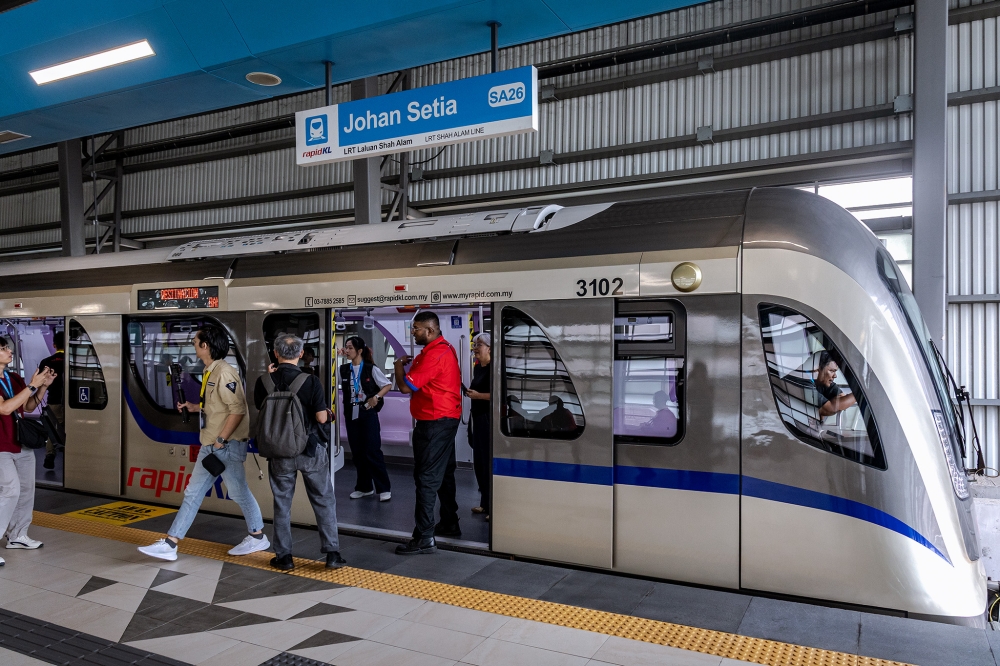
PETALING JAYA, June 29 — The first day of operations for the LRT3 Shah Alam Line got off to a smooth start today, with Prasarana Malaysia Bhd saying only minor teething issues emerged as it began monitoring passenger behaviour to fine-tune the new service.
Outgoing Prasarana president and group chief executive officer Amir Hamdan said train operations, station facilities and passenger movement remained under control throughout the morning, with trains operating at peak-hour headways of around eight minutes.
“So far, everything appears to be under control. During peak hours, the headway is around eight minutes, and operations as well as station facilities are functioning well.
“There are some minor feeder service issues, but nothing significant. It is normal when a new line opens.
“Once many people begin using the ticketing machines and fare gates, we will be able to identify what improvements need to be made,” he told reporters during a media ride from Glenmarie 2 station to Bandar Utama station.
In rail operations, headway is the time between one train and the next.
Amir, together with media personnel, was inspecting the first-day of the Shah Alam Line, travelling from Glenmarie 2 to Bandar Utama station to observe passenger movement, station operations and the overall commuter experience.
Amir said the first day of operations also gave Prasarana an opportunity to observe passenger flow, particularly at interchange stations where commuters transfer between the Shah Alam Line and existing rail services.
“We are looking at how passengers move between the Shah Alam Line and the Kelana Jaya Line today, so we can see what further improvements can be made,” he said.
Curious commuters and first impressions
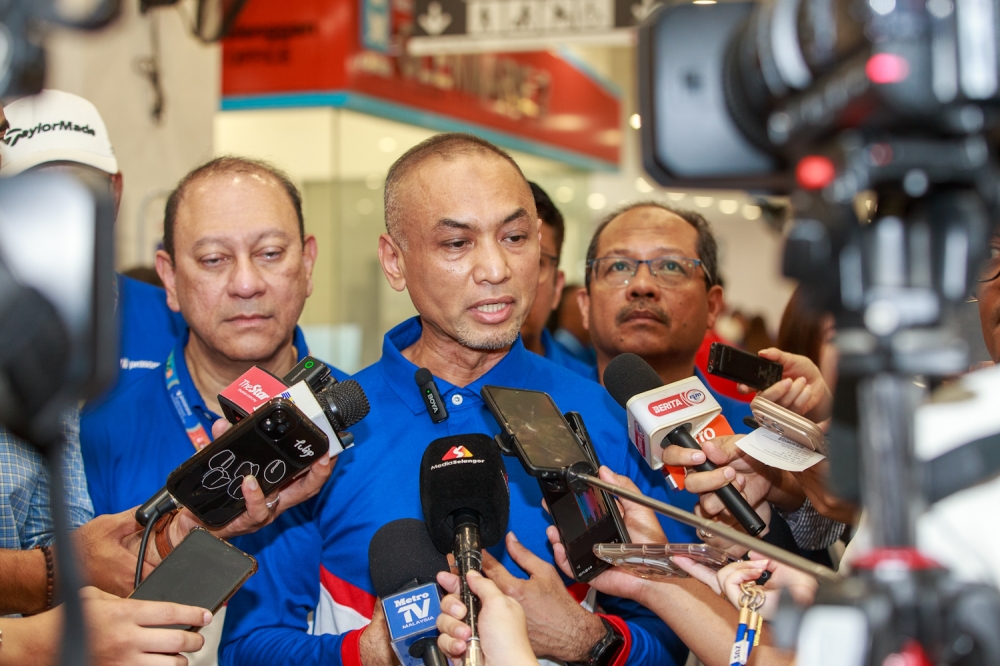
He said the public response had been encouraging, with many commuters travelling simply to experience the new line, including families with children, office workers and university students.
“Earlier, when I travelled from Bandar Utama to Stadium Shah Alam, the trains were busy. Many passengers were taking videos and enjoying the experience.
“Some also told us that stations such as Kerjaya serve office areas, so they are looking forward to commuting to work more comfortably without having to drive, while also avoiding traffic congestion,” he said.
During the journey, the trains were noticeably busy, particularly at interchange stations such as Glenmarie 2 and Bandar Utama, which connect to the Kelana Jaya and Kajang MRT lines respectively.
While some families treated the inaugural service as a day out with their children, others boarded the train simply to get to work.
At the Glenmarie 2 station, Prasarana staff was on hand to direct commuters transferring to the Kelana Jaya Line, as some found the steel barriers and unfamiliar interchange layout confusing to navigate.
Encouraging early ridership
Amir said Prasarana estimated between 5,000 and 10,000 passengers used the line this morning, describing the figure as encouraging given it was both a working and school day.
The operator is targeting average daily ridership of 67,000 passengers per day during the line’s first year of operations.
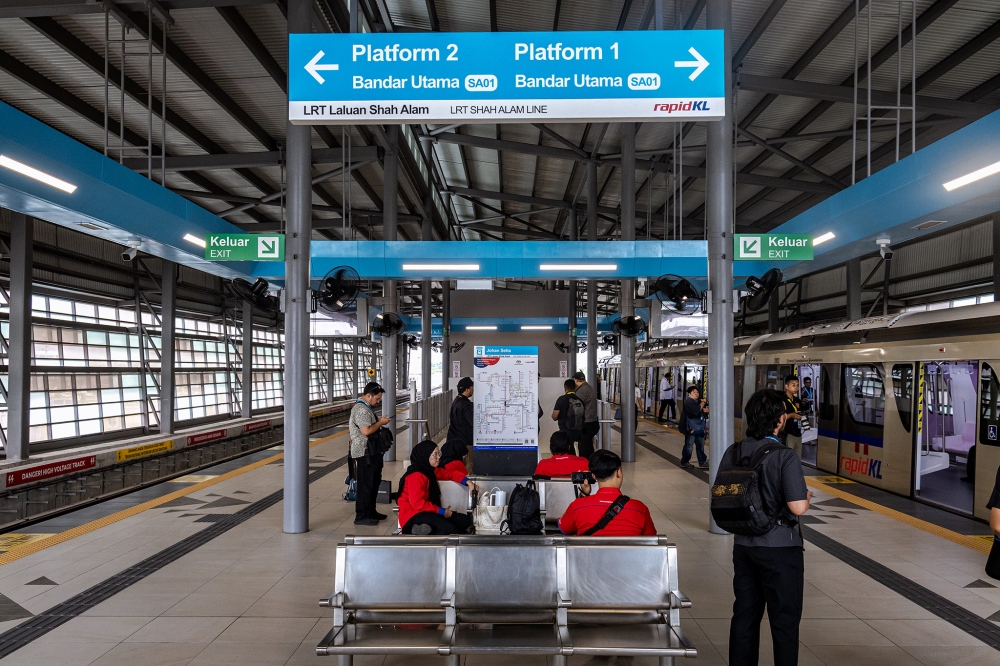
“When the MRT Putrajaya Line opened, the numbers were around that level (5,000 to 10,000 ridership) too, although it is a much larger system and covering a longer distance than the Shah Alam Line.
“Our first-year target is 67,000 passengers a day. Today is both a working day and a school day, so people will need time to get used to the new service.
“For me, 5,000 to 10,000 passengers on the first day this morning would be very encouraging,” he said.
No women-only coach yet, more upgrades ahead
On possible future improvements, Amir said Prasarana has yet to consider introducing a women-only coach, adding that any such decision would depend on passenger surveys and actual demand.
He also said the operator plans to eventually install platform safety barriers along the Shah Alam Line as part of a wider rollout already underway on the Kelana Jaya and Ampang lines.
Under the programme, the first two stations on both existing lines are expected to receive the barriers by the end of August, with 10 stations on each line to be completed by year-end and the remainder next year.
The Shah Alam Line comprises 20 stations and is being supported by 44 feeder buses and 40 Rapid KL On-Demand vans.
Rides on both the rail line and its feeder buses will be free until July 31.
Date: 29 June, 2026 1:00 pm
Source: Malay Mail
💬 Join the Conversation! 💬
We’ve disabled comments on our posts and pages to keep the discussions organized and lively! But don’t worry – the conversation isn’t over. Head over to our forum and share your thoughts, ideas, and feedback with the community! It’s the perfect place to connect, learn, and engage with others who care about the same things. We can’t wait to hear from you!